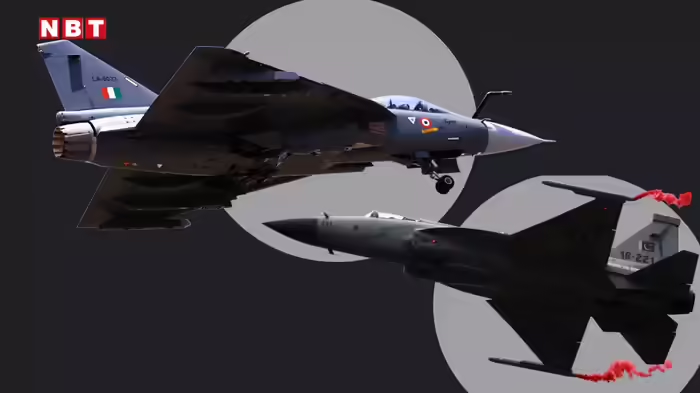
The debate between India’s Tejas and Pakistan’s JF-17 Thunder has resurfaced following Pakistan’s Defence Minister Khawaja Asif’s recent statement that Islamabad plans to sell the Chinese-made JF-17 to repay IMF loans. Both aircraft boast unique features, and in a conflict scenario, they could face off in the skies.
Tejas: India’s Indigenous Powerhouse
Developed by Hindustan Aeronautics Limited (HAL), the Tejas is a light, agile, 4+ generation fighter designed entirely by Indian engineers. Powered by the American GE F404-GE-IN20 engine, it can achieve a top speed of Mach 1.8 (approx. 2,220 km/h) and has a range of 3,000 km with aerial refueling. The aircraft can reach altitudes of up to 50,000 feet and carries a 30mm cannon along with air-to-air and air-to-ground missiles, bombs, and other armaments. Lightweight and fast, Tejas is praised for its advanced technology and superior safety record, with only one accident reported in March 2024, in which the pilot survived.
JF-17: Pakistan’s Cost-Effective Fighter
The JF-17, developed jointly by Pakistan and China and also known as the Thunder, is powered by the Russian RD-93 engine and can reach Mach 1.6 (approx. 1,975 km/h). Its standard range is 1,200 km, extendable with in-flight refueling, and it too can fly up to 50,000 feet. The aircraft carries a 23mm cannon, missiles, and bombs. While the JF-17 is more affordable at $15–20 million per aircraft, compared to Tejas’ $30–40 million, it has a checkered safety record, with four crashes reported since 2011, resulting in pilot fatalities.
Head-to-Head: Performance vs Cost
While Tejas outperforms the JF-17 in terms of speed, range, armament, and safety, the JF-17 offers a low-cost, reliable option for Pakistan. Both aircraft are 4th generation fighters with modern avionics, yet the choice between them depends on whether technological superiority or budget constraints takes precedence.
In the skies over South Asia, the Tejas and JF-17 represent two contrasting approaches to modern aerial warfare—one focusing on high-end technology and safety, the other on affordability and operational efficiency.
Discover more from SD NEWS agency
Subscribe to get the latest posts sent to your email.