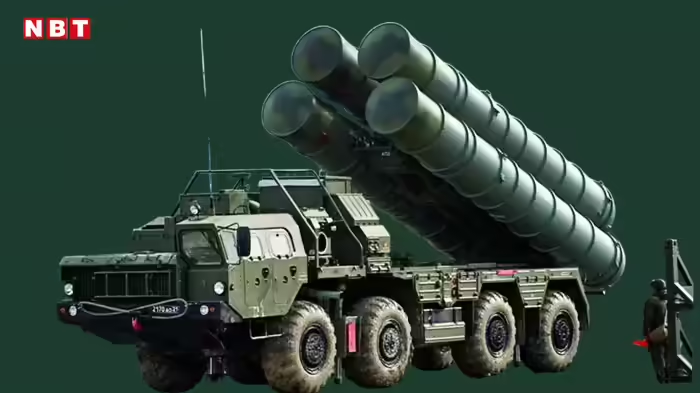
India is rapidly advancing toward self-reliance in long-range air defense with the ambitious Project Kusha of the Defence Research and Development Organisation (DRDO). Under this initiative, India is developing a new generation of interceptor missiles designed to match—or even surpass—the capabilities of Russia’s formidable S-400 air defense system. Armament Research and Development Establishment (ARDE) chief Ankanthi Raju has shared key insights into this high-profile project.
Three-Layered Air Defense: M1, M2, and M3
Project Kusha aims to create a “layered air defense shield” with three specialized interceptors—M1, M2, and M3. Together, these missiles will neutralize a wide spectrum of aerial threats, including fighter jets, cruise missiles, and other critical airborne targets. The project’s ultimate goal is to bring India’s indigenous capabilities on par with the world’s most advanced systems, and eventually exceed them.
- M1 Interceptor – First Line of Defense (150 km Range):
The M1 interceptor is designed for medium-range defense with a striking range of 150 km. Its performance surpasses systems like the Russian 9M96E2 (120 km range), enabling it to engage and destroy threats at extended distances with high precision and speed. - M2 Interceptor – Backbone of the Shield (250 km Range):
The second variant, M2, is a long-range interceptor with a 250 km range, putting it on par with the S-400’s 48N6DM and 48N6E3 missiles. M2 will serve as the core of Project Kusha’s long-range air defense, offering robust protection against fast-moving and high-altitude targets. - M3 Interceptor – Strategic Strike Weapon (350–400 km Range):
The most advanced missile in the series, M3, currently has a confirmed range of 350 km, slightly less than the S-400’s 40N6E (400 km). However, ongoing improvements are expected to extend M3’s range to 400 km, allowing it to penetrate enemy airspace and neutralize targets with strategic precision.
First Trial Expected by 2028
The DRDO plans the first trial of the M3 interceptor by 2028. This timeline will allow engineers to refine propulsion, guidance systems, and radar integration, ensuring the missile achieves its full 400 km operational potential by the time it is tested. Once deployed, Project Kusha is expected to significantly strengthen India’s strategic air defense capabilities, creating a protective shield likened to the “spikes of a porcupine” around the nation.
With Project Kusha, India is taking a major step toward an advanced, indigenous, and highly capable air defense architecture, signaling a new era of self-reliance in national security technology.
Discover more from SD NEWS agency
Subscribe to get the latest posts sent to your email.