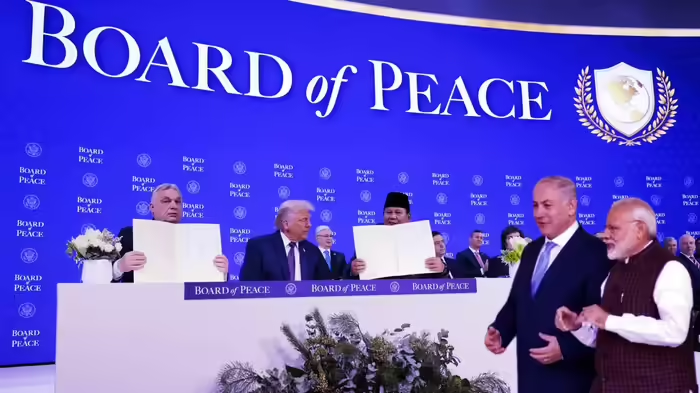
New Delhi: As global attention remains fixed on the ongoing Israel-Palestine conflict, a fresh diplomatic initiative by the United States has brought Gaza back to the center of international negotiations. US President Donald Trump has proposed the formation of a “Gaza Board of Peace”, with its first formal meeting scheduled to take place on February 19 in Washington.
However, India has so far stayed away from the initiative, and indications suggest that New Delhi is unlikely to participate in the first meeting. Even though the matter was discussed recently during the India–Arab League Foreign Ministers’ meeting in Delhi, India has not publicly revealed its stand, choosing instead to observe the regional response carefully.
First Meeting of the Gaza Peace Board in Washington
According to reports, the inaugural meeting will be held at the Donald J. Trump US Institute of Peace in Washington. Sources indicate that the Indian government is still reviewing the proposal to join the board. But with limited time remaining before the first meeting, India’s participation now appears highly unlikely.
India’s cautious approach signals a desire to avoid premature commitment in a politically sensitive and highly polarised geopolitical setting.
India Yet to Join, But Strategy Remains Crucial
India has consistently supported the two-state solution as the only sustainable path for peace between Israel and Palestine. At the same time, under Prime Minister Narendra Modi’s leadership, India-Israel relations have strengthened significantly, expanding in defence cooperation, technology, security, agriculture, and innovation.
This balancing act—maintaining strong ties with Israel while supporting Palestinian aspirations—has long been India’s diplomatic identity in West Asia. Any decision to join Trump’s initiative would require New Delhi to ensure that its historical position on Palestine is not diluted.
Pakistan-Turkey Partnership Adds a Major Challenge
One of the biggest concerns for India is the reported Pakistan-Turkey alignment within the proposed peace board. Both countries have frequently taken strong anti-Israel positions and have also been openly critical of India on international platforms.
Reports suggest that the Trump administration had earlier even encouraged Pakistan to consider sending forces to Gaza, adding further complexity to the situation.
If Pakistan and Turkey play influential roles in the board, India may find it diplomatically challenging to coordinate simultaneously with Israel, Palestine, Arab nations, and Western powers—without being drawn into politically motivated narratives.
PM Modi Expected to Visit Israel This Month
A key development likely to shape India’s future approach is Prime Minister Narendra Modi’s expected visit to Israel later this month. If confirmed, it would mark his first trip to Israel since 2017.
Sources suggest the Prime Minister may travel to Tel Aviv and Jerusalem, and the visit is expected to focus heavily on security cooperation and regional geopolitical shifts.
Given the rapidly changing dynamics in West Asia, Modi’s Israel visit may also reflect India’s broader strategic intent—especially regarding peace negotiations, regional stability, and counter-terrorism cooperation.
Netanyahu May Also Join the Peace Board Meeting
International media reports indicate that Israeli Prime Minister Benjamin Netanyahu could also attend the Gaza Peace Board meeting. If this happens, it would be a significant diplomatic moment, potentially becoming Netanyahu’s first engagement with Arab and Muslim leaders since the Hamas attacks of October 2023.
Such a meeting could redefine the diplomatic landscape, and India’s future participation may depend on how the board evolves after its first session.
India’s Diplomatic Balancing Act
India’s hesitation appears rooted in strategic caution. Joining the board could offer India a greater voice in shaping peace efforts, but it also carries risks—especially if rival nations attempt to use the platform to isolate India diplomatically or politicise the Gaza issue.
For now, India seems to be following a calculated path: observing the developments, listening to Arab nations, maintaining strong ties with Israel, and keeping its traditional two-state policy intact.
With West Asia undergoing a major geopolitical reshuffle, India’s next steps—especially after PM Modi’s Israel visit—could define its long-term role in any future Gaza peace framework.
Discover more from SD NEWS agency
Subscribe to get the latest posts sent to your email.