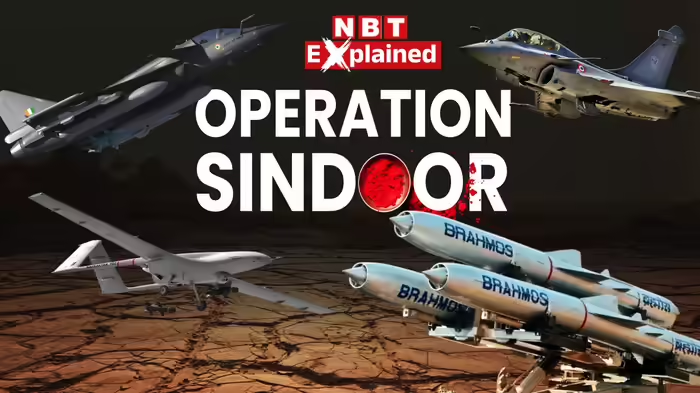
New Delhi: Indian Army Chief General Upendra Dwivedi has delivered a strong message to Pakistan, stating that India’s military is fully prepared to respond to any aggression along the India-Pakistan and India-China borders. Speaking at his first press conference of 2026, General Dwivedi emphasized that Operation Sindur, launched last May in response to terrorist attacks in Jammu & Kashmir and Pakistan-occupied Kashmir (PoK), demonstrated India’s capability, coordination, and readiness for ground action. He warned that even American support will not save Pakistan from India’s defensive and offensive capabilities.
Operation Sindur: A Model of Joint Force Coordination
General Dwivedi described Operation Sindur as a prime example of inter-service coordination, carried out with clear political directives and complete operational freedom. “Future military responses will be joint operations, reflecting the strategic vision of Prime Minister Narendra Modi,” he said. He added that victory in future conflicts will not come from a single branch of the military but through national-level collaboration, where self-reliance and rapid deployment are key.
Northern Front Stable but Vigilance Needed
Commenting on the broader security situation along the northern front, General Dwivedi said that while conditions remain stable, constant vigilance is necessary. High-level discussions, renewed contacts, and confidence-building measures have helped normalize activities along the borders, allowing essential operations such as grass cutting, water clinics, and infrastructure work.
Strengthened LAC Deployment Against China
At the India-China border (LAC), General Dwivedi confirmed that Indian deployments remain strong and strategically balanced. He reiterated India’s firm stance on Shaksgam Valley, rejecting Chinese claims and Pakistan’s 1963 handover. India continues to consider the region legally and historically its own territory.
India’s 15-Year Defence Modernization Plan
According to the Indo-Pacific Defense Forum, India’s 15-year modernization plan includes the development of its first nuclear-powered aircraft carrier, capable of deploying indigenous fighter jets. The plan also calls for at least 10 nuclear-powered propulsion systems for future warships, reinforcing India’s strategic reach in the Indian Ocean.
India aims to induct 62 Rafale jets by 2030, including 36 for the Air Force, in addition to ramping up deployment of LCA Tejas light combat aircraft and twin-engine carrier-based fighters. The INS Vikrant and INS Vikramaditya will host these aircraft, enhancing India’s maritime and aerial capabilities. Special emphasis is also being placed on drone technology, which played a key role during Operation Sindur in May 2025.
Pakistan Admits It Cannot Beat India
Najam Sethi, a close associate of former Pakistani Prime Minister Nawaz Sharif, publicly acknowledged that Pakistan cannot win a conventional war against India. Sethi claimed that Pakistan has not signed a first-use nuclear agreement with India, but even with U.S. support, it lacks the capacity to prevail against Indian forces.
Operation Sindur: Tactical Success
During Operation Sindur, India struck terrorist camps in Pakistan and PoK, eliminating over 100 terrorists, including those involved in the deadly April 22 attack in Pahalgam, Jammu & Kashmir, carried out by Pakistan-based LeT affiliate The Resistance Front. Pakistan’s missile and drone strikes were neutralized by Indian forces, and counterattacks targeted Pakistani airbases. A ceasefire was declared on May 10, 2025.
General Dwivedi’s message is clear: India is battle-ready, strategically coordinated, and capable of swift, decisive action—ensuring that Pakistan’s reliance on external powers like the U.S. will not shield it from India’s military response.
Discover more from SD NEWS agency
Subscribe to get the latest posts sent to your email.