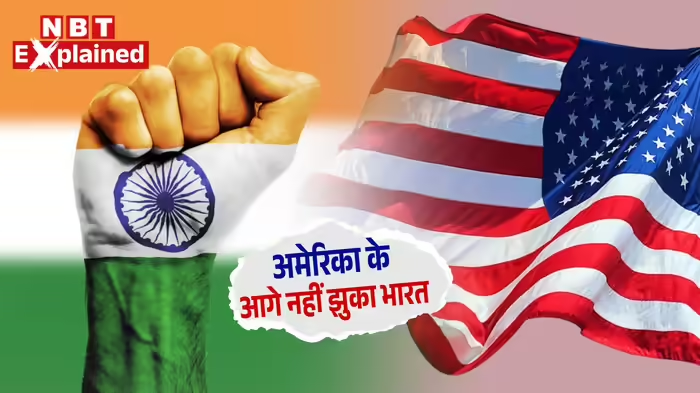
India and the United States are yet to finalize a bilateral trade deal, even as U.S. President Donald Trump once again referred to Prime Minister Narendra Modi as his “good friend” and a respected global leader. Despite the warm words, India is advancing with extreme caution, carefully weighing each step in ongoing negotiations over tariffs and trade barriers.
Trump Expresses Optimism for Trade Deal
Speaking at the 56th Annual World Economic Forum in Davos, Switzerland, Trump expressed confidence that both countries would reach a beneficial agreement on the proposed Bilateral Trade Agreement (BTA). The deal, first discussed during PM Modi’s visit to Washington in February 2025, aims to increase bilateral trade from approximately $191 billion to $500 billion by 2030 — more than double the current level.
Trump reiterated his admiration for PM Modi, calling him a “wonderful person” and a “trusted friend,” signaling a positive intent despite ongoing economic tensions and geopolitical challenges.
Ongoing Trade Tensions
U.S.-India trade relations have been tense, with the United States imposing tariffs of up to 50% on several Indian exports, citing issues including India’s import of oil from Russia and its participation in BRICS. In response, India has implemented selective counter-tariffs on U.S. agricultural products. Recently, two U.S. senators wrote to Trump urging the reduction of tariffs on American pulses exported to India.
Continued Negotiations
Despite high tariffs, India’s exports to the U.S. remain relatively stable. In December, India exported goods worth $6.89 billion, marginally lower than $7.01 billion in December 2024 and $6.98 billion in November 2025. Commerce Secretary Rajesh Agrawal confirmed that negotiations have continued without interruption. A virtual meeting between India’s Commerce Minister Piyush Goyal and U.S. Trade Representative Jamison Greer in late December addressed pending issues, while an American delegation visited New Delhi in December. Newly appointed U.S. Ambassador Sergio Gore also expressed optimism about the trade deal after taking charge on January 14.
Foreign Minister S. Jaishankar has been actively engaging with U.S. counterparts, including Secretary of State Marco Rubio, on trade, critical minerals, nuclear cooperation, defense, and energy issues.
India Remains Cautious Amid Flattering Statements
Trump’s repeated praise for Modi has been coupled with threats of steep tariffs, with warnings of up to 500% duties in past months. India, however, has not fallen for these overtures. U.S. Commerce Secretary Howard Lutnick recently claimed that negotiations stalled because Modi did not call Trump within three weeks — a claim denied by the Indian Ministry of External Affairs. Spokesperson Randeep Jaiswal confirmed that India has been actively engaged in talks since February 13, 2025, and is committed to finalizing a mutually beneficial trade agreement as soon as possible.
Key Issues Ahead
The major challenges in reaching a trade deal involve U.S. dairy and agricultural products, as India is unwilling to compromise the interests of its farmers and dairy producers. Other affected sectors include textiles, jewelry, leather, and seafood, where exporters face narrowing profit margins due to high tariffs. Without an agreement to reduce these barriers, many exporters fear they cannot sustain long-term competitiveness in the U.S. market.
India is thus treading cautiously, balancing the goal of boosting bilateral trade with the need to protect domestic industries and farmers’ interests.
Discover more from SD NEWS agency
Subscribe to get the latest posts sent to your email.