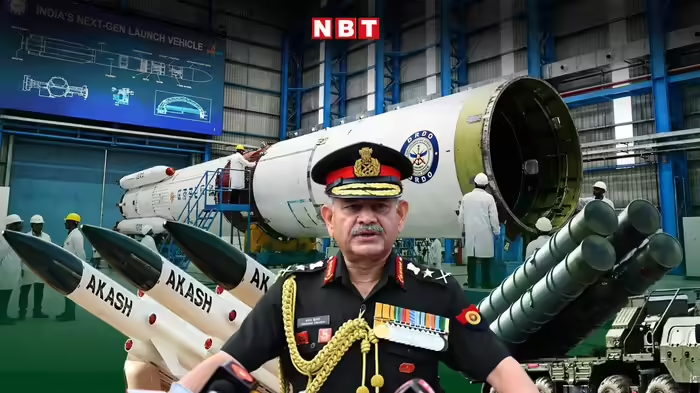
Indian Army Chief General Upendra Dwivedi has announced that India is moving towards the creation of a dedicated Rocket–Missile Force, a major step aimed at significantly enhancing the country’s combat capabilities in modern warfare. Drawing lessons from Operation Sindoor, General Dwivedi said the evolving regional security environment makes such a force a strategic necessity.
Speaking at a press conference ahead of Army Day, the Army Chief said India must adapt to changing modes of warfare, where rockets, missiles, drones, and air defence systems play a decisive role. Both China and Pakistan already operate specialised rocket or missile forces, and India can no longer afford to lag behind, he asserted.
Why India Needs a Rocket–Missile Force
General Dwivedi said the time has come for India to integrate long‑range rockets and missiles under a single, unified command.
“In modern warfare, rockets and missiles can no longer be treated as separate capabilities. If we want to create a meaningful impact on the battlefield, both must operate under one command structure,” he said.
The proposed Rocket–Missile Force will include:
- Long‑range rockets
- Ballistic and cruise missiles
- Armed drones
- Air defence weapons
Pakistan has already raised a rocket force, while China’s People’s Liberation Army Rocket Force (PLARF) is considered one of the most powerful arms of its military.
What Will the Rocket–Missile Force Include?
The Army Chief highlighted key weapons systems that will form the backbone of the new force:
Pinaka Multi‑Barrel Rocket Launcher
Developed by DRDO, Pinaka is India’s indigenous multi‑barrel rocket system. The guided version currently has a range of 120 km, with contracts signed to extend it to 150 km. Future variants are expected to reach 300–450 km, significantly boosting India’s deep‑strike capability.
Pralay Missile
Pralay is a short‑range ballistic missile with a range of 150–500 km. It is designed to destroy high‑value enemy targets such as airbases, radar stations, and command centres deep inside hostile territory.
BrahMos Cruise Missile
BrahMos, jointly developed by India and Russia, is a supersonic cruise missile capable of flying at Mach 3. With a range of 290–450 km, it can be launched from land, sea, or air platforms and is known for its speed, precision, and lethality.
China and Pakistan: The Strategic Context
General Dwivedi made it clear that rising threats from India’s neighbours are a key driver behind the move.
China’s PLA Rocket Force, established as a separate branch in 2016, has been continuously modernised and plays a central role in Beijing’s military doctrine. Pakistan, too, has raised a dedicated rocket force to strengthen its strike capabilities.
“With both our neighbours possessing such forces, it is imperative for India to establish its own Rocket–Missile Force to maintain deterrence and operational superiority,” the Army Chief said.
A Major Shift in India’s War Doctrine
The proposed Rocket–Missile Force signals a significant shift in India’s military thinking—from platform‑centric operations to integrated, high‑impact strike capabilities. It reflects India’s intent to prepare for future wars that are likely to be fast, technology‑driven, and precision‑focused.
As India faces simultaneous challenges on multiple fronts, the move is being seen as a decisive step to ensure strategic balance against China and Pakistan.
Discover more from SD NEWS agency
Subscribe to get the latest posts sent to your email.