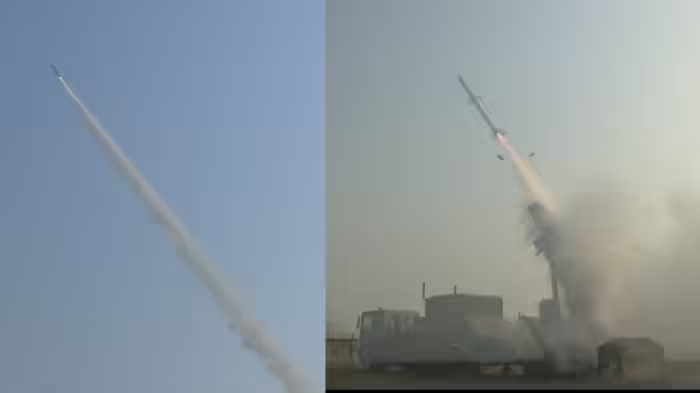
India on Tuesday successfully conducted the user evaluation trial of the Akash Next Generation (Akash-NG) missile system, a significant milestone in strengthening the country’s indigenous air defence capabilities. The trial met all Preliminary Staff Qualitative Requirements (PSQRs), officials said.
Developed by the Defence Research and Development Organisation (DRDO) and manufactured by Bharat Dynamics Limited (BDL), the Akash-NG system demonstrated its effectiveness by successfully intercepting multiple aerial targets under diverse operational conditions.
Successful Interception Across Ranges and Altitudes
According to DRDO, the missiles intercepted aerial threats at varying ranges and altitudes, including low-altitude, long-range targets near border areas as well as high-altitude scenarios. The successful trials underline the system’s capability to counter a wide spectrum of aerial threats.
Equipped with an indigenous Radio Frequency (RF) seeker and powered by a solid rocket motor, Akash-NG is designed to deliver rapid response and high accuracy, enhancing India’s layered air defence architecture.
Why Akash-NG Is Significant
Defence officials described Akash-NG as a state-of-the-art surface-to-air missile system, capable of engaging multiple targets simultaneously. The missile has an operational range of up to 30 kilometres and can intercept targets at altitudes of up to 18 kilometres.
With the successful completion of user evaluation trials, the induction of the Akash-NG system into the Indian Air Force and the Indian Army has moved a step closer. Once deployed, it is expected to significantly enhance India’s ability to defend critical assets and airspace against hostile aircraft, drones, and other aerial threats.
Part of a Broader Defence Push
Earlier this month, DRDO also carried out a successful high-speed rocket sled test of a fighter aircraft escape system at the Terminal Ballistics Research Laboratory (TBRL) rail track rocket sled (RTRS) facility in Chandigarh. The test was conducted at a precisely controlled speed of 800 km/h and validated key safety parameters, including full aircrew recovery.
Together, these achievements highlight India’s continued push towards self-reliance in defence technology and reinforce the country’s growing capabilities in advanced military systems.
Discover more from SD NEWS agency
Subscribe to get the latest posts sent to your email.