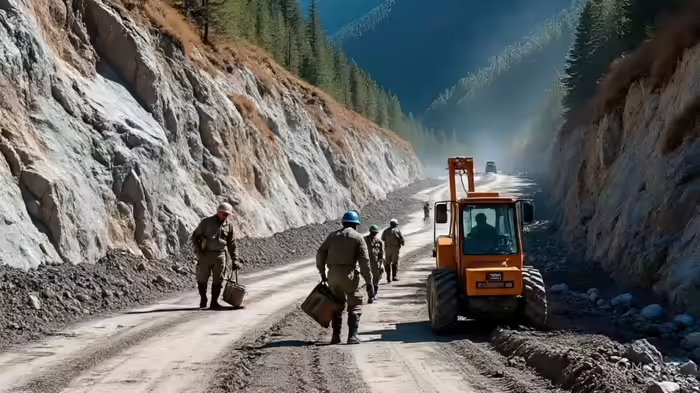
New Delhi, 26 Dec 2025: In a strategic move to bolster military preparedness against potential future clashes with China, India is rapidly enhancing its infrastructure in the Himalayas. The government is investing millions of dollars in constructing roads, tunnels, and airstrips across the high-altitude region to ensure faster mobilization of troops and supplies.
The initiative comes in the aftermath of the deadly 2020 clash with China along the Line of Actual Control (LAC), which exposed significant logistical shortcomings along the 2,200-mile disputed border. During the 2020 confrontation, Indian and Chinese soldiers engaged in hand-to-hand combat at altitudes of over 14,000 feet, with India struggling to quickly send reinforcements due to poor road connectivity.
Bridging the Gap in Border Logistics
According to military experts, while China has developed a vast network of roads and railways in its border regions over decades, India had lagged in ensuring swift access to its mountainous outposts. The new infrastructure projects aim to address this critical gap.
Former Major General Amrit Pal Singh, ex-Chief of Operational Logistics for India’s Ladakh sector, emphasized the need for a “paradigm shift” in border logistics and military strategy. Lieutenant General Deependra Singh Hudda, former commander of India’s Northern Command, highlighted that the projects will connect isolated high-altitude posts with nearby civilian settlements, particularly those cut off during harsh winters.
The Zoji La Tunnel – A Game Changer
Among the most ambitious projects is the Zoji La Tunnel, being built at approximately 11,500 feet in Northern India. Valued at over $750 million, work on the tunnel began immediately after the 2020 border clash. Stretching nearly nine miles, it is expected to be completed within two years and will significantly ease the transportation of supplies to remote posts in Ladakh, which can remain inaccessible for up to six months due to heavy snowfall.
Currently, supplies are transported via trucks or trains to depots in Jammu and Kashmir, then moved to Leh and further carried by smaller vehicles, porters, and mules to posts situated at altitudes of 20,000 feet. Each soldier requires roughly 100 kg of supplies per month, including food, clothing, and daily essentials, with a 30-person post consuming around 13 gallons of fuel daily. The tunnel will drastically reduce travel time and ensure year-round supply movement.
Accelerated Construction Amid Harsh Conditions
Over 1,000 construction workers are operating in extreme cold, where temperatures can drop to minus 40°F. Ensuring proper ventilation for workers and later for diesel-powered military vehicles remains a major engineering challenge.
Strategic Importance of Roads and Bridges
Tensions remain high around Pangong Tso Lake, a flashpoint for several India-China clashes. Following the 2020 Galwan Valley conflict, both nations accelerated construction in the area. Beijing recently completed a bridge connecting the northern and southern banks of the lake, allowing troops to traverse directly instead of taking longer detours.
India’s proactive measures demonstrate its commitment to national security and readiness for any potential confrontation with China. The rapid development of border infrastructure will enhance troop deployment and supply capabilities in previously inaccessible regions, addressing long-standing logistical challenges.
Discover more from SD NEWS agency
Subscribe to get the latest posts sent to your email.