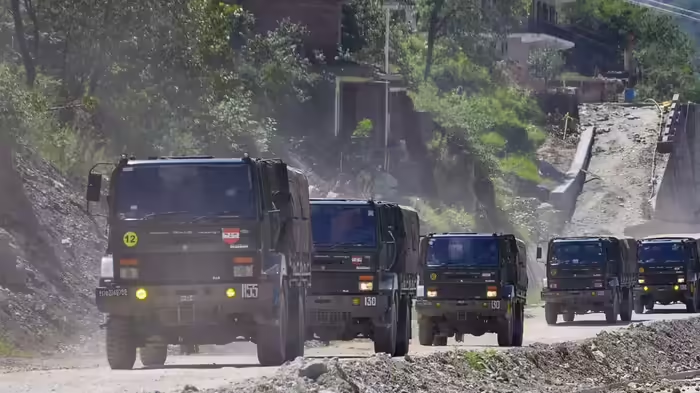
India is undertaking a major expansion of strategic infrastructure across the Himalayan region as part of its preparations to counter a potential future confrontation with China, according to a report by the US-based Wall Street Journal. The report claims that New Delhi is investing hundreds of millions of dollars in building roads, tunnels and airstrips to strengthen troop deployment and logistics along the disputed border areas.
The move comes against the backdrop of sustained tensions along the nearly 2,200-mile-long Line of Actual Control (LAC), which separates India and China and has remained a flashpoint for decades. The violent clash in eastern Ladakh’s Galwan Valley in 2020 marked a turning point, exposing critical gaps in India’s border connectivity and military mobility.
Lessons from Galwan
Military analysts cited in the report noted that during the 2020 standoff, China was able to mobilise reinforcements within hours, thanks to its extensive road and rail network in Tibet. In contrast, India’s forces often required days—sometimes up to a week—to reach forward areas due to rugged terrain and inadequate infrastructure.
This disparity, experts say, prompted a strategic rethink in New Delhi. Former senior military officials have acknowledged that the Galwan incident underscored the urgent need to overhaul connectivity in border regions, not only for defence preparedness but also for sustained logistical support in high-altitude areas.
Roads, Tunnels and Airstrips
Since 2020, India has accelerated multiple infrastructure projects aimed at linking remote Himalayan outposts with military bases and nearby civilian settlements. These include all-weather roads, high-altitude tunnels to bypass snowbound passes, and upgraded airstrips capable of supporting rapid troop movement and emergency supplies.
The focus, according to analysts, is to ensure that Indian forces can match China’s speed and flexibility in mobilising troops along the LAC, thereby strengthening deterrence and reducing strategic vulnerability.
Heightened Activity Around Pangong Lake
The report also highlights increased infrastructure activity around Pangong Tso, the high-altitude lake stretching from India’s Ladakh region into China’s Tibet Autonomous Region. The area has been a major point of contention since 2020, with both sides enhancing their presence.
China, the report notes, has recently completed a bridge connecting the northern and southern banks of the lake, significantly easing military movement. In response, India too has stepped up construction of roads and supporting infrastructure in the surrounding region to improve access and readiness.
Strategic Significance
Defence experts believe India’s infrastructure push signals a long-term shift in border strategy—from reactive deployments to sustained forward preparedness. While officials in New Delhi have consistently maintained that these projects are defensive in nature, the scale and pace of construction underline the seriousness with which India is addressing the evolving security challenge posed by China.
As geopolitical competition intensifies across the Himalayas, the race to build roads, tunnels and airstrips is increasingly seen as central to maintaining balance and deterrence along one of the world’s most sensitive borders.
Discover more from SD NEWS agency
Subscribe to get the latest posts sent to your email.