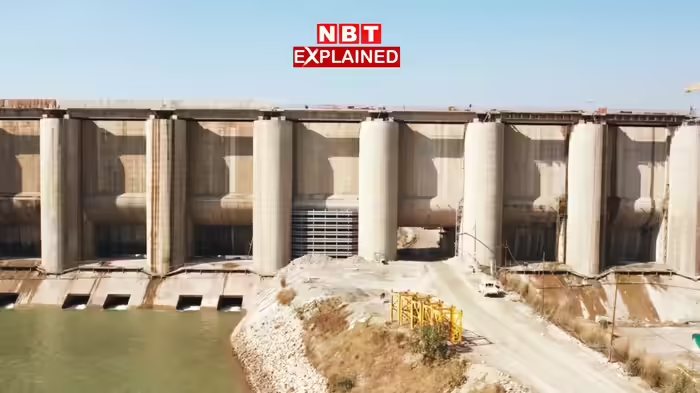
New Delhi, February 23, 2026: India is set to significantly tighten control over the waters of the Ravi River as the long-pending Shahpur Kandi Dam project nears completion, a move that could intensify water stress in Pakistan ahead of the peak summer season. Simultaneously, India has accelerated desilting operations on the Chenab River, further altering the regional water equation.
The developments come amid heightened bilateral tensions and the suspension of the 1960 Indus Waters Treaty by India in 2025 following the Pahalgam terror attack.
Shahpur Kandi Dam Nears Completion
The Shahpur Kandi Dam, located along the Punjab–Jammu and Kashmir border in Pathankot district, is expected to be completed by the end of March 2026. Once operational, the dam will enable India to fully utilize waters of the Ravi that previously flowed unutilized into Pakistan due to inadequate infrastructure.
Under the Indus Waters Treaty, India has exclusive rights over the eastern rivers — Ravi, Beas, and Sutlej — and is permitted unrestricted use for irrigation, power generation, and storage.
Until now, excess floodwaters from the Ravi often crossed into Pakistan via the Madhopur headworks. With the new infrastructure in place, India will be able to regulate and store approximately 11,500 cusecs of water, preventing surplus flows downstream.
The Rs 3,000-crore project also includes a 206 MW hydropower component, expected to bolster northern India’s energy security and support irrigation for nearly 32,000 hectares of farmland. The project is aligned with the Centre’s “Har Khet Ko Pani” initiative aimed at maximizing irrigation coverage.
Chenab Desilting Gains Momentum
India has also initiated large-scale desilting operations in the Chenab basin, particularly at the Salal Hydroelectric Power Station in Jammu and Kashmir’s Reasi district.
Over time, sediment accumulation had drastically reduced the reservoir’s capacity — from an original 284 million cubic meters (MCM) to just 9.91 MCM by May 2025. Following the commencement of desilting efforts, capacity has reportedly increased to 14 MCM as of January 2026.
Authorities have issued tenders to reopen six under-sluice gates that had remained permanently closed under earlier treaty constraints. Approximately 1.7 lakh metric tonnes of silt are being removed to improve hydropower efficiency and storage capacity.
Implications for Pakistan
Pakistan, which relies heavily on river waters for agriculture — nearly 90% of its total water usage — may face additional stress during the summer cropping season. Experts estimate that Pakistan requires around 80 billion cubic meters of water annually, with Ravi waters contributing significantly to irrigation in Punjab province and supply to cities such as Lahore.
With India now moving to fully utilize its share of eastern river waters and enhancing operational efficiency on the Chenab, surplus flows that once reached Pakistan may diminish.
Islamabad has raised concerns on diplomatic platforms, warning of a potential humanitarian crisis. New Delhi, however, maintains that it is acting within its treaty rights and correcting decades of underutilization of allocated waters.
Water as a Strategic Lever?
The developments highlight the increasingly strategic role of water in India–Pakistan relations. Past disputes over projects such as Kishanganga and Ratle had already strained ties. The current measures underscore India’s zero-tolerance approach toward cross-border terrorism and its resolve to optimize domestic resource use.
Climate change and glacial melt in the Himalayas further complicate the situation, intensifying pressure on the Indus river system shared by the two nuclear-armed neighbors.
Prime Minister Narendra Modi is expected to inaugurate the Shahpur Kandi Dam in late March, marking the culmination of a project whose origins date back to the 1920s but remained stalled for decades due to inter-state disputes.
As summer approaches, the geopolitics of water in South Asia appears poised to enter a new and potentially volatile phase.
Discover more from SD NEWS agency
Subscribe to get the latest posts sent to your email.