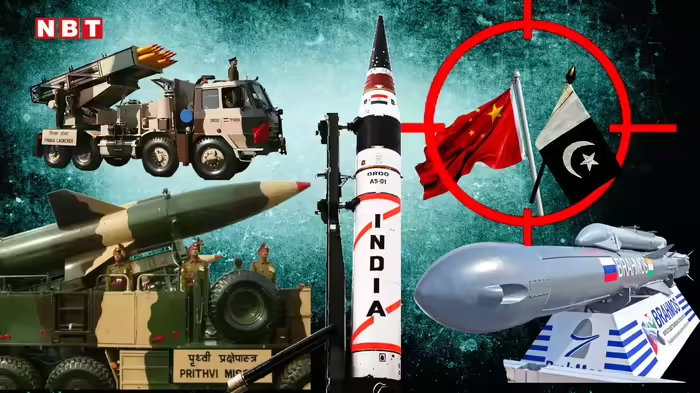
New Delhi, January 15, 2026 – Indian Army Chief General Upendra Dwivedi has emphasized the urgent need to establish a dedicated Rocket-Missile Force in India, drawing inspiration from Iran’s powerful missile capabilities, which are known to make even the United States and Israel cautious.
Modern Warfare Demands Specialized Forces
Speaking ahead of Army Day, General Dwivedi highlighted that conventional warfare is increasingly obsolete. Modern conflicts focus on non-contact and high-tech operations, a reality India has already experienced during Operation Sindhur, where Pakistani forces, equipped with American and Chinese weapons, were overpowered.
“The security environment requires a specialized military unit capable of deploying long-range rockets and missiles under a single command,” said the Army Chief. He noted that both China and Pakistan already maintain dedicated rocket-missile units, and India must match this capability to address threats along its borders.
Current Status and Capabilities
Currently, India’s long-range rocket and missile arsenal is managed separately by the Army Air Defense Corps (AAD) and various artillery regiments. Recent tests include the Pinaka Long Range Guided Rocket with a 120 km range, while agreements are reportedly in place for missiles with 300–450 km range. India’s missile inventory includes Agni, BrahMos, Prithvi, and Pralaya systems, among others.
General Dwivedi emphasized the growing interdependence of rockets and missiles in modern warfare, stating, “Both systems complement each other, and coordinated deployment enhances operational impact.”
Lessons from Iran
If India aims to develop an independent Rocket-Missile Force, Iran offers valuable insights. The Islamic Revolutionary Guard Corps Aerospace Force (IRGCASF) manages Iran’s extensive missile arsenal, operating ballistic, hypersonic, and cruise missiles, alongside combat drones. Reporting directly to Supreme Leader Ayatollah Ali Khamenei, this unit has successfully demonstrated its capabilities in conflicts, including confrontations with Israel, where it bypassed the Iron Dome defense system, causing significant damage.
A key strength of Iran’s missile force is its underground tunnel network, which conceals missiles and launch systems, making detection and targeting extremely difficult. Estimates suggest Iran possesses nearly 3,000 ballistic missiles, the highest in Central Asia, a fact that has historically restrained full-scale military action by the US and Israel.
Regional Context
While Pakistan has also established its Army Rocket Force Command (ARFC) following Operation Sindhur, and China fields the People’s Liberation Army Rocket Force (PLARF) with over 1,250 ballistic and cruise missiles and hundreds of nuclear warheads, India seeks to carve a technologically advanced and integrated missile force capable of deterring regional threats.
General Dwivedi concluded that a dedicated Rocket-Missile Force is “a timely necessity” to safeguard India’s strategic interests, enhance deterrence, and ensure readiness in the evolving landscape of modern warfare.