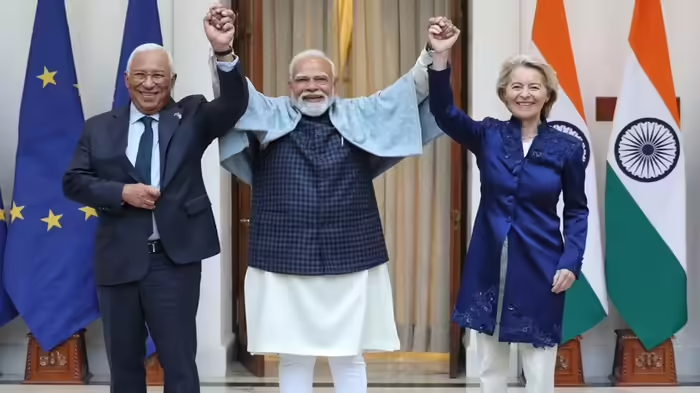
At the India-European Union (EU) summit, both sides held extensive discussions on strategic agendas, multilateralism, and global institutional reforms. They expressed concern over ongoing global issues such as the Ukraine conflict, the situation in Gaza, and developments in Iran, while strongly condemning terrorism in all its forms. The summit culminated in a 2030 strategic partnership roadmap encompassing sustainability, security, connectivity, and green energy cooperation.
Focus on Multilateralism and UN Reform
India and the EU underscored the importance of a multilateral system centered on the United Nations. Both sides advocated for comprehensive reforms of the UN Security Council, calling for a body that is transparent, effective, inclusive, and accountable in the current geopolitical context. They also emphasized the need to reform the World Trade Organization (WTO).
The summit highlighted adherence to international law in maintaining a peaceful and free Indo-Pacific. Both parties expressed keen interest in the Indo-Pacific Ocean Initiative and agreed to strengthen cooperation within the Indian Ocean Rim Association under India’s chairmanship.
Global Issues: Ukraine, Gaza, and Iran
The leaders voiced concern over the ongoing conflict in Ukraine and stressed the importance of dialogue and diplomacy for lasting peace. The joint statement reaffirmed respect for the UN Charter, emphasizing sovereignty and territorial integrity.
Regarding the Gaza crisis, the summit welcomed the peace board initiatives and endorsed a two-state solution as a long-term resolution. The situation in Iran was also discussed, with both sides expressing concern.
Condemnation of Terrorism and Extremism
India and the EU jointly condemned violent extremism and cross-border terrorism. They agreed to collaborate on anti-money laundering standards, counter-terror financing, and curbing the misuse of new technologies for terrorism. The statement specifically denounced attacks such as the Pulagam incident and the Red Fort terrorist attack in New Delhi.
2030 Strategic Partnership Agenda
The India-EU 2030 agenda focuses on sustainability, defense and security, connectivity, and broader global issues. The partnership is designed to be a reliable framework for navigating complex geopolitical challenges. Key areas of collaboration include new technologies, innovation, and research. The summit launched the EU-India Innovation Hub and the EU-India Startup Partnership.
Science, Technology, and Green Energy Cooperation
India and the EU agreed to advance joint research in AI, quantum computing, advanced semiconductors, clean technology, and biotechnology. Strategic cooperation will extend to large AI language models, AI training centers, and digital ecosystems, with applications in healthcare, agriculture, and other sectors.
Green energy was a key focus, including the India-EU Green Hydrogen Task Force and the upcoming India-EU Wind Business Summit. Both sides also agreed to collaborate on environmental, education, and skill-development initiatives.
Key Agreements and Future Roadmap
- MoU between India’s RBI and EU Securities and Markets Authority
- Security of information cooperation between India and EU
- Framework for mobility and skill exchange programs
- Establishment of the Green Hydrogen Task Force
- Renewal of agreements on scientific and technical cooperation (2025–2030)
- Collaboration under the Horizon Europe program
- Disaster management and humanitarian aid cooperation
- Implementation of four joint projects, including digital innovation and skill hubs for children and women, solar solutions for women farmers, and sustainable energy transition projects in Africa
The summit marks a significant step in deepening India-EU strategic ties while addressing global challenges through shared action and multilateral cooperation.
Discover more from SD NEWS agency
Subscribe to get the latest posts sent to your email.