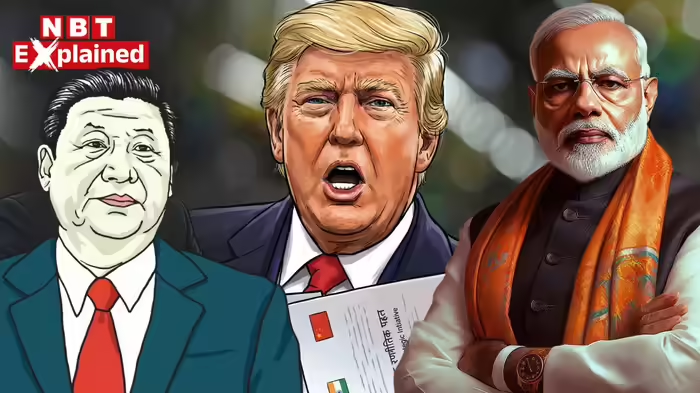
New Delhi: The world is witnessing escalating US assertiveness, with threats ranging from territorial claims over Greenland to military action against Iran. Washington has also warned of 500% tariffs on India and China for purchasing oil from Russia. Under former President Donald Trump’s second term, US policy has taken an unusually confrontational turn. While direct military conflict remains unlikely, a coordinated India-China economic strategy could significantly weaken America’s leverage.
US National Debt in 2026
As of 9 January 2026, the United States’ gross national debt stands at approximately $38.43 trillion, including $30.8 trillion owed to the public and $7.63 trillion in intergovernmental holdings. The pace of borrowing has accelerated, with total debt rising by $2.25 trillion in 2025 alone, averaging over $8 billion per day. On a per capita basis, this amounts to roughly $115,000 per American citizen.
Rising Interest Burden
According to Times Now, the US faces significant pressure from interest payments, with net interest costs reaching $276 billion in the final quarter of 2025 due to higher rates and an expanding debt stock. The US primarily finances this burden through Treasury bills, notes, and bonds, which are considered among the world’s safest assets due to the dollar’s reserve currency status. Heavy reliance on foreign buyers, however, creates strategic vulnerabilities.
Foreign Holdings and Strategic Implications
Foreign investors collectively hold around $8.5 trillion in US Treasury securities, a crucial pillar of American debt financing. This stable demand keeps US interest rates lower, allowing Washington to fund deficits, infrastructure, and military operations at relatively low cost. China, the second-largest holder with about $759 billion in Treasuries, leverages this system to stabilize the renminbi and support its export-driven economy. By recycling trade surpluses into US debt, China indirectly boosts demand for its exports.
India-China Rapprochement Challenges the QUAD
According to The Diplomat, bilateral ties are sensitive and influenced by both internal and external factors. Since Trump imposed steep tariffs in response to China’s assertive policies, India’s engagement with China has increased, raising questions about the future cohesion of the QUAD (comprising the US, Japan, Australia, and India).
Russia-China-India Alliance: A New Opportunity
Reports suggest that China is exploring closer ties with India, alongside Russia, creating a potential trilateral RIC (Russia-India-China) coalition. This was evident during the Shanghai Cooperation Summit in Tianjin, where the three leaders were seen together, causing unease in Washington. India-China relations have warmed following Modi-Xi meetings in Kazakhstan, including measures such as reopening religious pilgrimages in Tibet for Indian citizens and easing visa rules for Chinese nationals in India. High-level talks to resolve border issues have also resumed.
Strategic Balancing Act
India faces the delicate task of balancing its growing partnership with the US, including QUAD commitments, with its economic and security relations with China. The US remains India’s largest trading partner, while India remains dependent on China for critical components, such as solar panel parts, highlighting the complexity of this triangular relationship.
China’s Leverage Over the US
China controls nearly 90% of global rare earth production and has restricted supplies to the US. It also halted purchases of US soybeans and corn, causing market disruption and forcing Washington to turn to alternative suppliers, including India.
BRICS and Economic Autonomy
India assumed the BRICS presidency on 1 January, coordinating with Russia, Brazil, China, and South Africa to facilitate trade in local currencies instead of the US dollar. BRICS nations represent 35–40% of global GDP with a combined population of nearly 3 billion. Washington has expressed discomfort over these moves, as seen in Trump’s past dismissive remarks about BRICS.
US Incentives for India
Recognizing India’s growing strategic and technological significance—particularly in chip design, AI, and advanced technologies—Washington continues to court New Delhi. US Ambassador Sergio Gaur recently emphasized strong bilateral ties and extended an invitation for India to join the upcoming PAX Silica forum, highlighting India’s indispensable role in global tech and economic architecture.
Discover more from SD NEWS agency
Subscribe to get the latest posts sent to your email.