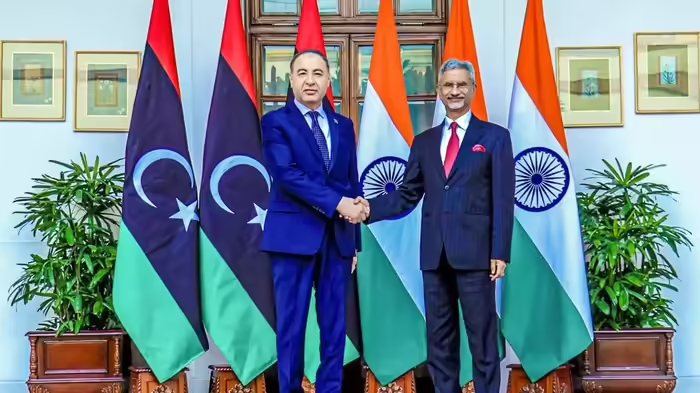
India and Arab nations are set to hold their second high-level meeting of foreign ministers on Saturday, a significant step aimed at reinforcing diplomatic and strategic ties between India and the Arab world. The meeting will be co-chaired by India and the United Arab Emirates (UAE) and will include foreign ministers from the Arab League member states as well as the Secretary-General of the Arab League.
A Decade Since the First Meeting
This is the first ministerial-level gathering in ten years, following the inaugural India-Arab Foreign Ministers’ meeting held in Bahrain in 2016. The 2016 meeting had identified five key areas of cooperation: economy, energy, education, media, and culture, proposing several collaborative initiatives across these sectors.
The upcoming meeting aims to deepen and expand this partnership, providing the most important institutional platform for bilateral and multilateral engagement. The framework for India-Arab cooperation formally began in March 2002 with the signing of a Memorandum of Understanding between India and the Arab States League (LAS). Subsequent milestones include the 2008 establishment of the India-Arab Cooperation Forum and its 2013 organizational restructuring. India currently participates as an observer in the League of Arab States, which comprises 22 member countries.
Key Expectations and Strategic Significance
Around 15 foreign ministers from Arab countries are expected to attend, potentially including Syria’s Foreign Minister Assad Hasan Al-Shaybani. A ministerial-level dialogue between New Delhi and Damascus would mark a first since the formation of the HTS-led government under Ahmad Al-Shara.
The meeting gains additional significance amid growing tensions in Yemen between Saudi Arabia and the UAE. In December, Saudi forces targeted a UAE-bound shipment of weapons and equipment at the Al-Mukalla port, prompting the UAE to temporarily withdraw from Yemen.
Recent months have also seen Saudi Arabia strengthen strategic ties with Pakistan and Turkey, while the UAE has bolstered relations with Israel, adding layers of regional complexity to the discussions.
The India-Arab foreign ministers’ meeting is therefore being closely watched as a crucial platform to reinforce diplomatic engagement, address regional challenges, and navigate geopolitical tensions in West Asia amid ongoing tariff and economic concerns.
Discover more from SD NEWS agency
Subscribe to get the latest posts sent to your email.