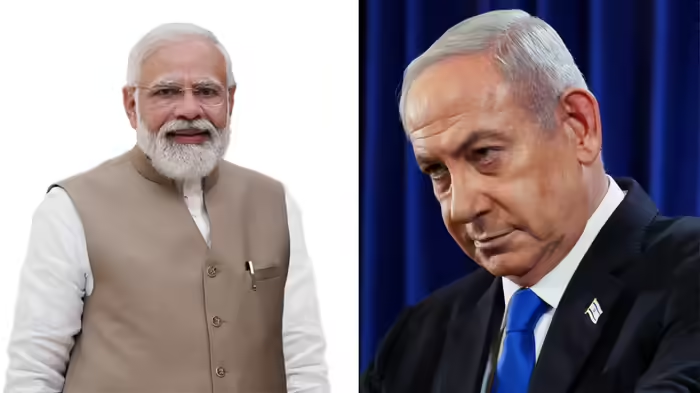
New Delhi: Prime Minister Narendra Modi will embark on a two-day state visit to Israel on February 25, marking another significant milestone in the deepening strategic partnership between the two nations. Israeli Prime Minister Benjamin Netanyahu has described the visit as an opportunity to strengthen bilateral ties and advance discussions on a proposed regional framework referred to as the “Hexagon Alliance.”
Announcing the visit during a recent cabinet meeting, Netanyahu said Modi would address the Israeli parliament, the Knesset, underscoring the importance Israel attaches to the visit. He emphasized that India and Israel have significantly reinforced their relationship in recent years and are now poised to expand cooperation across economic, diplomatic, and security domains.
What Is the ‘Hexagon Alliance’?
The “Hexagon of Alliance” is a proposed six-nation strategic framework aimed at enhancing cooperation across West Asia and the Mediterranean. According to Netanyahu, the initiative seeks to consolidate partnerships among countries that share common security concerns and strategic interests, particularly in countering regional instability and extremist threats.
The proposed grouping is expected to include Israel and India, alongside Mediterranean partners such as Greece and Cyprus, as well as select Arab and African nations. While specific details remain under wraps, Netanyahu has indicated that the framework would focus on coordinated action in defense, economic connectivity, technology collaboration, and regional stability.
He described the concept as an “axis of pragmatic nations” united by shared challenges and long-term strategic goals.
Strategic Context
The proposal appears to be positioned as a counterweight to what Israel has often described as the “radical axis,” particularly the Iran-aligned network sometimes referred to as the “Axis of Resistance.” This loosely connected grouping includes Tehran-backed organizations such as Hezbollah, which has played a prominent role in regional conflicts.
Tensions in the region have remained high since the October 7, 2023 attacks by Hamas, which triggered the ongoing conflict in Gaza. Israel has also faced confrontations with Iran-backed factions across multiple fronts, further intensifying geopolitical polarization in West Asia.
Netanyahu suggested that a broader coalition of like-minded states could provide greater strategic resilience against such threats.
Diplomatic Realities and Challenges
Despite the ambitious vision, the proposed alliance remains at a conceptual stage. No participating government has formally endorsed the initiative, and analysts caution against interpreting it as a treaty-based or NATO-style bloc.
Some of the countries mentioned—such as Greece and Cyprus—are members of the International Criminal Court, which has legal proceedings involving Israeli leadership related to the Gaza conflict. This adds a layer of diplomatic complexity to the proposal.
Security experts note that the “Hexagon” may evolve more as a flexible platform for strategic coordination rather than a formal defense pact. Such an arrangement could facilitate ad hoc security cooperation, intelligence sharing, economic projects, and technology partnerships without binding treaty obligations.
India’s Role
For India, participation in any such framework would align with its broader foreign policy approach of multi-alignment—engaging major global and regional powers while safeguarding its strategic autonomy. India has steadily strengthened defense and technology ties with Israel over the past decade, with cooperation spanning cybersecurity, agriculture, innovation, and counter-terrorism.
Modi’s visit is therefore expected to focus not only on bilateral initiatives but also on exploring avenues for broader regional collaboration.
As Netanyahu put it, “These countries may have different perspectives, but through cooperation, we can ensure strength and secure our shared future.”
Whether the Hexagon Alliance materializes as a structured bloc or remains an evolving diplomatic concept, the upcoming Modi-Netanyahu meeting is set to shape the next phase of India–Israel strategic engagement in an increasingly volatile region.
Discover more from SD NEWS agency
Subscribe to get the latest posts sent to your email.