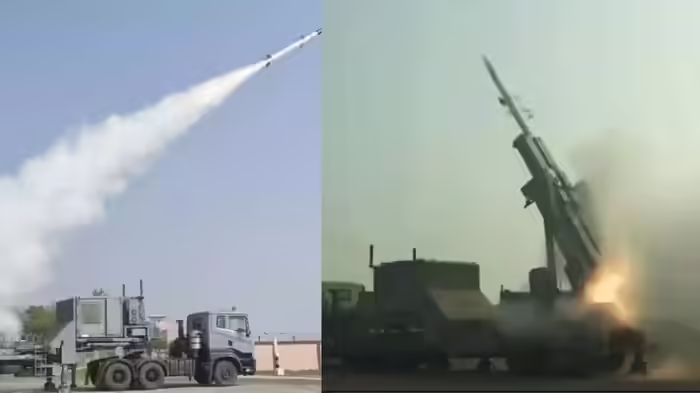
India has achieved a significant milestone in its defence capabilities with the successful testing of the Akash Next Generation (NG) Missile System, a development likely to raise concerns in neighboring China and Pakistan. The Defence Research and Development Organisation (DRDO) confirmed that the user evaluation trials of the Akash-NG system have been successfully completed, paving the way for its induction into the Indian Armed Forces.
Outstanding Performance Against Aerial Threats
During the trials, the Akash-NG demonstrated high precision against a wide range of aerial targets, including fast-moving objects, low-altitude intruders, and targets located at long distances and high altitudes. Defence experts have hailed this achievement as a significant boost to India’s air defence capability.
10 Key Features of the Akash-NG Missile System
- Fully Indigenous Technology: The missile system is equipped with a domestically developed Radio Frequency (RF) seeker, ensuring precise target acquisition.
- Advanced Propulsion: It uses a dual-pulse solid rocket motor, providing enhanced power and superior control.
- Indigenous Radar and C2 Systems: The radar and command-and-control (C2) components are fully developed in India, reinforcing self-reliant defence technology.
- Multi-Target Capability: Designed to engage multiple targets simultaneously, with a range of 30 km and a maximum altitude of 18 km.
- Integration with Armed Forces: The successful trials bring the missile system closer to deployment in the Indian Air Force and Indian Army, strengthening national air defence.
- Comprehensive Threat Coverage: Capable of intercepting fighter jets, helicopters, drones, cruise missiles, and air-to-surface missiles.
- Strategic Deterrence: When deployed near borders, the system can neutralize aerial threats within a 70–80 km radius.
- State-of-the-Art Testing Facility: Trials were conducted at the Terminal Ballistics Research Laboratory (TBRL) in Chandigarh using the Rail Track Rocket Sled (RTRS) facility.
- High-Speed Test Accuracy: The rocket sled was operated at a controlled speed of 800 km/h, validating missile performance under extreme conditions.
- Safety and Recovery Protocols Verified: All critical safety standards, including complete aircrew recovery, were successfully tested, ensuring operational reliability.
Boost to Indigenous Defence and National Security
The Defence Ministry stated that the successful trials not only enhance India’s defensive preparedness but also provide fresh momentum to indigenous defence research. With Akash-NG, India’s air defence network is set to become more robust, self-reliant, and technologically advanced, significantly strengthening the country’s strategic deterrence.
Discover more from SD NEWS agency
Subscribe to get the latest posts sent to your email.