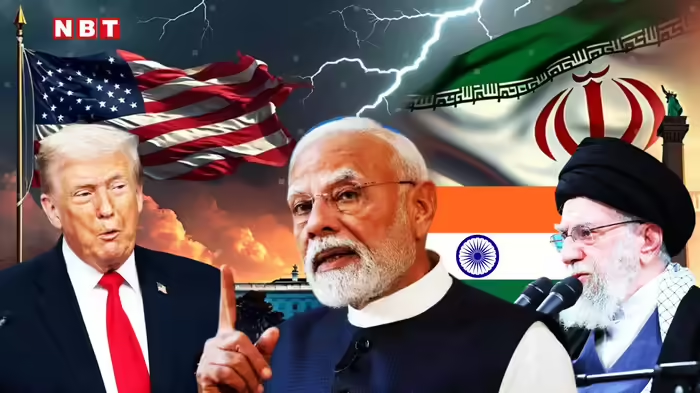
Rising tensions between the United States and Iran have reached a critical point, raising serious concerns across the world. Iran has asserted complete control over the strategically vital Strait of Hormuz, while the United States has warned of strong retaliation against any provocation. If this standoff escalates into a full-scale conflict, its repercussions will extend far beyond West Asia—India would be among the countries most affected.
Threat to India’s Energy Security
One of the biggest risks for India lies in energy supplies. Iran contributes around 4–5% of global oil production, and nearly half of India’s crude oil and liquefied natural gas (LNG) imports pass through the Strait of Hormuz. Any disruption in this narrow maritime route could sharply reduce supplies, driving up global oil prices. For India, which depends heavily on energy imports, this would mean higher fuel costs, increased inflation, and added pressure on the economy.
Impact on the Indian Economy and Inflation
A surge in crude oil prices would have a cascading effect on transportation, manufacturing, and household expenses. Rising fuel costs often translate into higher prices for essential goods, increasing the burden on consumers and complicating the government’s efforts to control inflation.
Risks to Indian Expatriates in the Gulf
An estimated 8–9 million Indians live and work in Gulf countries such as Saudi Arabia, the UAE, and Qatar. Any military conflict in the region could threaten their safety and livelihoods. Past crises in West Asia have shown that evacuations and disruptions in remittances can have significant social and economic consequences for India.
Trade and Export Challenges
Although India’s direct trade with Iran is relatively small—around 0.3% of total exports—the indirect impact could be substantial. The United States has warned of imposing tariffs of up to 25% on countries continuing trade with Iran. This could hurt Indian exports such as basmati rice, fruits, and dry fruits, while also disrupting supply chains, logistics, and payment mechanisms.
Chabahar Port and Strategic Concerns
India’s investment in Iran’s Chabahar Port is another area of concern. The port is strategically crucial for India’s access to Afghanistan and Central Asia, bypassing Pakistan. Increased U.S. pressure or instability in Iran could slow down or jeopardize this project, weakening India’s regional connectivity plans. If India steps back, China may move in to fill the strategic vacuum.
Diplomatic Balancing Act for India
At the diplomatic level, India faces a delicate balancing act. On one hand, it has a strong strategic partnership with the United States; on the other, it must maintain workable relations with Iran to safeguard its regional and economic interests. India has often taken a neutral or independent stance on Iran-related resolutions at the United Nations, reflecting this careful approach.
Conclusion
A potential U.S.-Iran conflict would pose serious challenges for India—economically, strategically, and diplomatically. From energy security and inflation to the safety of millions of Indian expatriates and key geopolitical projects like Chabahar, the stakes are high. India will need to navigate this crisis with caution, ensuring that its foreign policy protects national interests while maintaining balance in a highly volatile region.
Discover more from SD NEWS agency
Subscribe to get the latest posts sent to your email.