New Delhi:
In a significant step towards modernisation and self-reliance in defence, the Indian Air Force (IAF) is preparing to retire its ageing Soviet-origin Mi-35 attack helicopters—popularly known as the ‘Flying Tanks’—and replace them with India’s indigenous Light Combat Helicopter (LCH) ‘Prachand’, designed specifically for high-altitude warfare.
End of an Era: Mi-35 Helicopters to be Phased Out
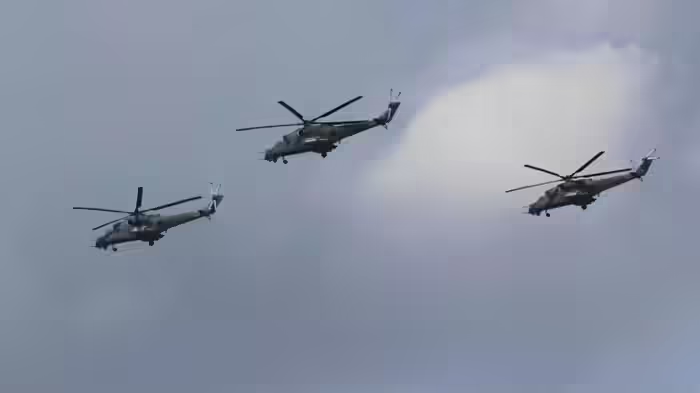
According to defence sources, the Mi-35 fleet will be completely phased out by 2030–31, marking the end of nearly four decades of service by Russian heavy attack helicopters in the Indian arsenal. The Mi-25 and Mi-35 helicopters, inducted during the 1980s and 1990s, earned the nickname ‘Flying Tanks’ due to their heavy armour, firepower, and capability to transport troops while delivering devastating strikes.
Several Mi-35 helicopters have already been retired, while a few were gifted to friendly nations, including four to Afghanistan. Though rugged and battle-proven, defence experts note that their heavy design makes them less agile and less suitable for modern warfare—particularly in mountainous and high-altitude regions.
Prachand Takes Centre Stage
As the Mi-35 exits service, Hindustan Aeronautics Limited’s ‘Prachand’ is set to assume a pivotal role in India’s combat helicopter fleet. The requirement for such a platform was strongly felt after the 1999 Kargil War, which exposed the limitations of existing helicopters in extreme high-altitude combat environments.
Today, Prachand stands out as the world’s only attack helicopter capable of operating at altitudes of up to 5,000 metres (16,400 feet)—a critical advantage for deployment in areas such as Siachen Glacier and Eastern Ladakh along the Line of Actual Control (LAC).
Equipped with advanced avionics, high-performance engines optimised for thin air, and stealth features to evade enemy radar, Prachand is tailored for India’s unique geographical and operational requirements.
No Capability Gap for the IAF
The retirement of the Mi-35 will not leave any operational void. The IAF already operates 22 Boeing AH-64E Apache helicopters, inducted between 2019 and 2021. The Apache serves as a formidable tank-buster, known for precision strikes and lethal battlefield dominance.
Going forward, India’s attack helicopter fleet will comprise a strategic mix of American Apache helicopters and indigenous Prachand platforms, combining heavy strike capability with high-altitude agility.
To strengthen this transition, the Defence Ministry has approved the procurement of 156 Prachand helicopters, of which 66 will be inducted into the IAF and 90 into the Indian Army Aviation Corps. Deliveries are scheduled to begin from 2028, ensuring seamless replacement as older helicopters are phased out.
Why the Shift Was Necessary
While Mi-35 helicopters were heavily armoured and versatile, modern warfare demands speed, stealth, and adaptability—especially in mountainous terrain. Heavy platforms struggle in high-altitude conditions, where lighter, more agile helicopters perform far better. Lessons from Kargil made it clear that India needed attack helicopters capable of sustained operations at extreme altitudes.
Prachand: Built for India, Built for the Future
Designed exclusively for high-altitude combat, Prachand’s ability to operate seamlessly at 5,000 metres makes it a global first in its class. Its state-of-the-art electronic systems provide superior situational awareness to pilots, while stealth features allow it to penetrate hostile airspace undetected.
A Stronger, Self-Reliant Air Force
With the gradual retirement of the Mi-35, the IAF’s future attack helicopter fleet will be defined by two pillars: the Apache, delivering unmatched heavy strike power, and Prachand, ensuring dominance in high-altitude warfare. Together, they will significantly enhance India’s combat readiness while reinforcing the nation’s push towards Atmanirbhar Bharat in defence manufacturing.
Discover more from SD NEWS agency
Subscribe to get the latest posts sent to your email.