New Delhi:
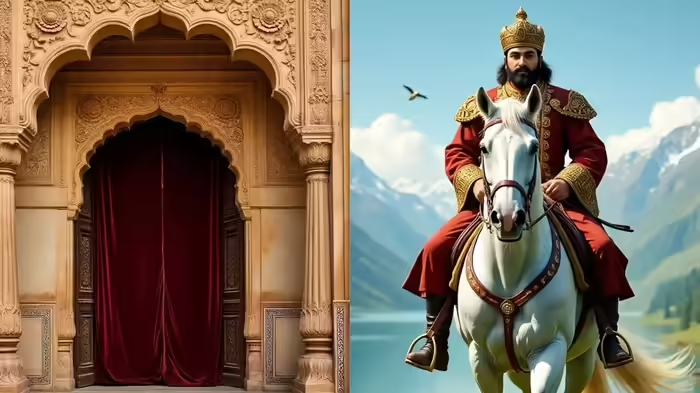
The story of Islam’s arrival in Kashmir is neither the result of a single invasion nor a sudden religious upheaval. Instead, it unfolded through a complex interplay of political collapse, social rigidity, and the personal journey of an unlikely figure—a Buddhist prince named Rinchana, whose transformation altered the course of Kashmiri history forever.
Kashmir’s historical narrative stretches from ancient myths to hard political realities of the 14th century. According to legend, the Kashmir Valley was once a vast lake called Satisar, drained through divine intervention by sage Kashyap. Over centuries, the region evolved into a flourishing centre of learning, spirituality, and culture.
From a Hindu-Buddhist Stronghold to a Fragile Kingdom
By the 3rd century BCE, Emperor Ashoka had introduced Buddhism to Kashmir, founding Srinagar and laying the foundations for the valley’s emergence as a major Buddhist centre. Under Kushan ruler Kanishka in the 1st century CE, Kashmir hosted the Fourth Buddhist Council, cementing its importance in the spread of Mahayana Buddhism across Asia.
In the 8th century, King Lalitaditya—often called the “Alexander of Kashmir”—expanded the kingdom far beyond the valley and built the grand Martand Sun Temple, symbolising Kashmir’s Hindu glory. However, by the time Kalhana wrote the Rajatarangini in the 12th century, central authority had weakened. Powerful feudal lords (Damars) dominated politics, temples were looted, irrigation systems collapsed, and the valley slipped into chaos and famine.
The Crisis of the 14th Century
In the early 1300s, Kashmir faced its darkest phase. During the weak reign of King Suhadeva, a Mongol commander named Dulucha invaded the valley in 1320. The king fled, leaving the population defenceless. Chronicler Jonaraja described villages in flames and mass killings that spared neither Brahmins nor Shudras. Though the Mongols eventually perished in a snowstorm while retreating, they left behind a devastated land—politically leaderless and socially shattered.
It was in this vacuum that three fugitives arrived in Kashmir:
- Shah Mir, a Muslim from Swat seeking political opportunity
- Lankar Chak, a Dardic chieftain escaping a blood feud
- Rinchana, a Buddhist prince from Ladakh whose father had been killed and who had fled for survival, not power
The Rise of Rinchana
Amid the anarchy, Rinchana emerged as a capable and calculating leader. He gathered his Tibetan followers, assassinated the powerful minister Ramachandra, and seized the throne. To legitimise his rule, he married Kota Rani, Ramachandra’s daughter and a symbol of Kashmir’s old royal lineage.
Despite his political success, Rinchana remained an outsider. Seeking acceptance, he approached the chief Shaivite priest Devaswami, expressing his desire to embrace Hinduism. The priest refused, declaring that a “mleccha” (foreign-born Buddhist) could not be admitted into the upper-caste Hindu fold.
A Turning Point: Embracing Islam
Rejected by the Brahminical establishment, Rinchana turned to the Sufi saint Bulbul Shah, who offered him spiritual acceptance without social barriers. Rinchana embraced Islam, adopted the name Sultan Sadr-ud-Din, and thus became Kashmir’s first Muslim ruler.
His conversion marked a profound shift. It broke the long-standing monopoly of Brahmins over state power and opened new psychological and social pathways for the Kashmiri people. In the aftermath of Mongol devastation, many saw that the old religious order had failed to protect them, while Islam—introduced through mysticism and equality—offered an alternative moral and political framework.
A Short Reign, a Lasting Impact
Rinchana ruled for only three years (1320–1323). The entrenched elite never fully accepted him, and he was fatally wounded in a palace conspiracy. Yet, even in death, his political foresight reshaped Kashmir’s future. He entrusted his young son and Queen Kota Rani to Shah Mir—an act that would prove decisive.
Kota Rani ruled for over a decade, becoming the last Hindu queen of Kashmir. Through strategic alliances and marriages, she held power during a transitional era. Eventually, Shah Mir ascended the throne, founding the Shah Mir dynasty, which firmly established Islamic rule in Kashmir.
The Birth of a New Kashmir
Rinchana’s life and conversion stand at the crossroads of Kashmir’s religious and political transformation. A Buddhist prince rejected by one faith and embraced by another, his story explains how Kashmir’s doors opened to Islam—not through force alone, but through social exclusion, spiritual openness, and historical circumstance.
Thus began a new chapter in the valley’s long and layered history—one where multiple cultures, faiths, and traditions would continue to shape Kashmir’s unique identity for centuries to come.
Discover more from SD NEWS agency
Subscribe to get the latest posts sent to your email.