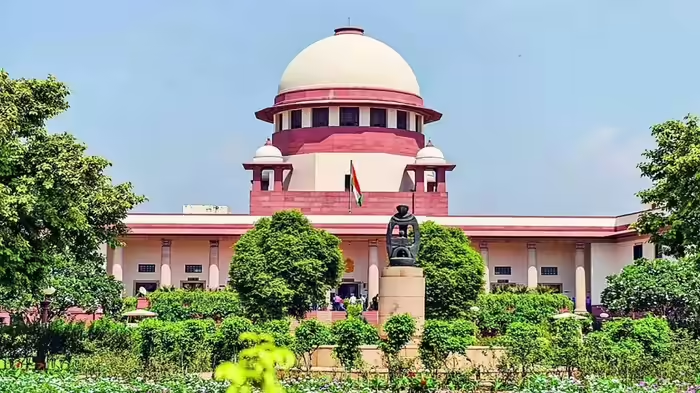
New Delhi: The Supreme Court of India has strongly cautioned constitutional court judges against assuming the role of subject experts while deciding cases. The apex court observed that High Court judges should not behave like “super-examiners” or domain specialists, as such an approach could be “dangerous” and may distract them from their primary constitutional duty of adjudicating disputes impartially.
The remark was made by a bench comprising Chief Justice Suryakant, Justice Joymalya Bagchi and Justice N.V. Anjaria while hearing a petition filed by the Jharkhand Public Service Commission (JPSC).
What Was the Case About?
The petition challenged a Jharkhand High Court order related to the recruitment of judicial officers. The High Court had directed that candidates appearing in the preliminary examination should be awarded marks for one of two answer options in a disputed question. It had also ordered that two questions be removed from evaluation.
JPSC approached the Supreme Court against this decision.
Why Did the Supreme Court Make This Observation?
During the hearing, the bench questioned whether a constitutional court should interfere in exam answer keys simply because the recruitment exam was meant for judicial services and the subject involved law.
Chief Justice Suryakant remarked that if High Court judges begin acting as domain experts, it could create a problematic precedent.
He explained that a judge might possess expertise in a particular field, but that does not mean the judge should intervene in technical matters outside the judicial role.
“Tomorrow a Judge May Know Biochemistry…”
To underline the danger of such judicial overreach, the Chief Justice gave a striking example, saying that even if a judge has knowledge of biochemistry, it does not mean the judge should start interfering in recruitment exams related to that field.
The bench stated that such issues should be left to domain experts, and courts should avoid acting as evaluators of question papers and answer keys.
Court Suggests Expert Committee Instead
The Supreme Court clarified that the proper course of action would be for the High Court, while exercising judicial review, to refer the issue to its administrative side and direct the formation of an expert committee.
The committee should include specialists in relevant subjects—including law and English—to re-examine the disputed answer keys and evaluation process.
Two-Week Deadline for Resolution
When lawyers requested an early resolution due to delays in recruitment, the Supreme Court directed the High Court to complete the exercise within two weeks and send a report to JPSC.
It was also highlighted during the hearing that no recruitment in Jharkhand judicial services has taken place for the last two and a half years.
In a related remark, the Chief Justice expressed concern that no advocates have been elevated as High Court judges since 2017, calling it a serious issue.
Key Message From the Supreme Court
The Supreme Court’s statement serves as a reminder that courts must remain neutral adjudicators, not technical evaluators. Judges must focus on examining legality and fairness, while leaving specialized technical assessments to qualified experts.
Discover more from SD NEWS agency
Subscribe to get the latest posts sent to your email.