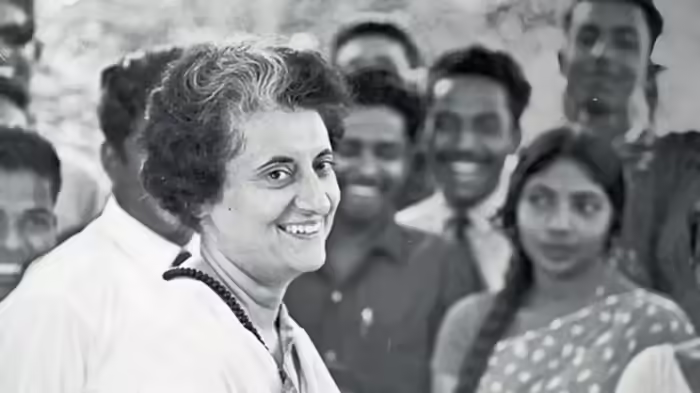
New Delhi: On 19 January 1966, an unprecedented scene unfolded in the Central Hall of Parliament, as the Congress Parliamentary Party (CPP), for the first time since India’s independence, elected its leader through a full-scale vote. After four hours of dramatic proceedings, 48-year-old Indira Gandhi emerged victorious, becoming India’s first woman Prime Minister.
The Times of India at the time described her entry: “Draped in a white sari with a light brown shawl over her shoulder, Indira received a thunderous welcome in the hall.” The returning officer declared, “I hereby declare Mrs. Indira Gandhi elected as Prime Minister.” The hall reverberated with cheers, marking not just a personal victory but a significant turning point in Congress’ internal succession politics.
Vacancy After Lal Bahadur Shastri’s Sudden Death
The prime ministerial post fell vacant in January 1966 after the sudden demise of Lal Bahadur Shastri in Tashkent. Acting PM Gulzarilal Nanda took temporary charge, while senior Congress leaders, including Morarji Desai and Indira Gandhi, emerged as contenders. Despite being the sole daughter of Jawaharlal Nehru, Indira had long remained in her father’s shadow. She had previously served as Minister of Information and Broadcasting under Shastri and was Congress President until 1960.
Support from 11 Chief Ministers
Following Shastri’s death, a fierce power struggle unfolded. Of the 16 state chief ministers, 11 openly supported Indira Gandhi, prompting Gulzarilal Nanda to withdraw from the race, while Morarji Desai refused to step back. Desai stated, “Why should I form a separate party? I am a true Congressman and have dedicated my life to the Congress.” What appeared to be a routine transition became one of the toughest leadership contests in independent India.
Accusations and Counterclaims
During the contest, Desai alleged that pressure was being applied on MPs to support specific candidates, implicitly referring to Indira Gandhi. Congress President K. Kamaraj countered, emphasizing that states’ opinions matter in a federal democracy. On the eve of voting, Desai told reporters that MPs were not “mindless animals” and that this contest was a battle between party leadership and the rank-and-file, refusing to disclose evidence of alleged coercion.
The Voting Drama in Delhi
As voting approached, Delhi saw heightened political activity. MPs sought support from state leaders, while media gathered outside the residences of Kamaraj, Desai, and Gandhi. On 19 January 1966, 526 Congress MPs gathered in the Central Hall. Morarji Desai arrived first, greeting everyone, followed by Indira Gandhi, who also exchanged a courteous namaste with Desai.
Desai was proposed by K. Hanumanthaiah, while Indira Gandhi was proposed by acting PM Nanda and supported by Sanjiv Reddy. Counting stretched through the afternoon, with four incorrect updates creating suspense. Finally, by 3 PM, the returning officer declared Indira Gandhi elected.
Indira Gandhi Wins 355 Votes
Indira Gandhi secured 355 votes, while Morarji Desai received 169, giving her around 68% of valid votes, a two-thirds majority. Amid cheers, both candidates shook hands and posed for photographers and television crews. After the announcement, Indira Gandhi went to Rashtrapati Bhavan to stake her claim to form the government, as the Central Hall echoed with her name.
First Press Conference and Global Reactions
In her first press conference, Indira dismissed any allegations of malpractice, stating: “There is no evidence of unfair practices in this election.” She also highlighted the importance of fearlessness in public life. Globally, reactions poured in—Soviet news agency TASS reported the news within minutes, while Lord Mountbatten described it as an election likely to bring stability to India.
Indira Gandhi’s historic ascent marked a new chapter in Indian politics, demonstrating that leadership in India could transcend gender barriers while navigating complex internal party dynamics.
Discover more from SD NEWS agency
Subscribe to get the latest posts sent to your email.