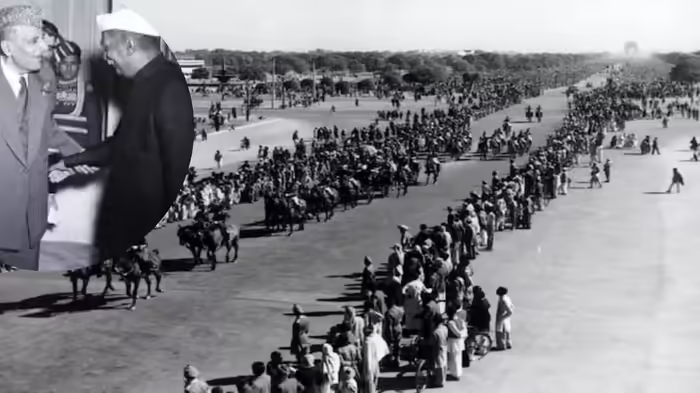
New Delhi, January 15, 2026 – India’s ties with Pakistan have long been marked by tension, primarily due to cross-border terrorism. Yet, there was a time when India invited the Governor-General of Pakistan as the Chief Guest at its Republic Day celebrations—a historical episode that is largely forgotten today.
Malik Ghulam Muhammad: A Brief Profile
The year was 1955, and the guest in question was Malik Ghulam Muhammad, then Pakistan’s Governor-General. This was a formative period for India, as it sought to establish its democratic institutions and ceremonial traditions.
Malik Ghulam Muhammad had strong administrative links with India. An alumnus of Aligarh Muslim University, he served under the British administration as a chartered accountant and worked in the Indian Railway Accounts Service before 1947. He was also the financial advisor to the Nizam of Hyderabad. Following Partition, he moved to Pakistan and became its first Finance Minister.
Military Backing and Constitutional Actions
After the assassination of Pakistan’s first Prime Minister Liaquat Ali Khan in 1951, Khwaja Nazimuddin assumed the Prime Ministership, while Malik Ghulam Muhammad became Governor-General. During his tenure, he dismissed the government of Prime Minister Nazimuddin in 1953 and dissolved Pakistan’s Constituent Assembly in 1954, with the support of senior military leadership, including General Ayub Khan, who would later become Army Chief and President.
The 1955 Republic Day Invitation
Despite post-Partition tensions, India extended an invitation to Malik Ghulam Muhammad to attend the 1955 Republic Day Parade on Rajpath (then Kingsway). This ceremony marked several historical firsts for India:
- Permanent venue on Rajpath: From 1950–1954, celebrations were held at multiple venues, including the Irwin Amphitheatre, Red Fort, and Ramleela Grounds. In 1955, Rajpath was fixed as the official parade route.
- Standardized parade format: Earlier parades varied widely in scale and organization. The 1955 event established a formal structure for future celebrations.
- Expanded ceremony: Military displays were larger and more organized, featuring Army, Navy, and Air Force contingents, with the Air Force flypast making its first major appearance.
- Introduction of cultural tableaux: For the first time, cultural presentations and state tableaux became part of the parade, adding a new dimension beyond purely military displays—a tradition that continues to this day.
Historical Significance
The decision to host Pakistan’s Governor-General reflected the nascent republic’s emphasis on diplomatic courtesy and regional engagement, despite underlying geopolitical tensions. It was also a formative year for Republic Day, laying the foundation for many of the parade’s enduring customs.
The 1955 parade remains a unique historical footnote—an instance where diplomacy, ceremony, and military display intersected in India’s early years as a republic.