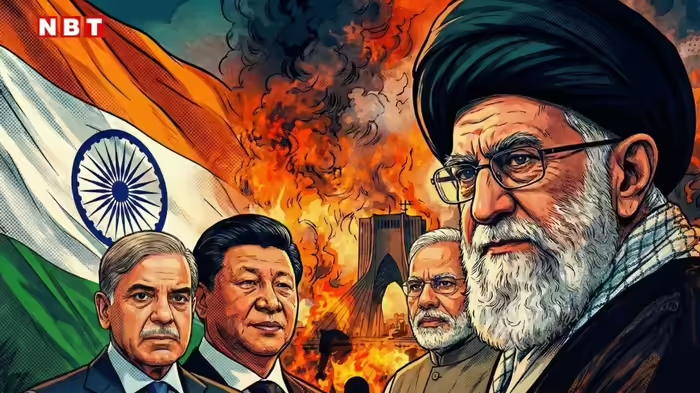
New Delhi, January 15, 2026 – India’s concern over the ongoing protests and political unrest in Iran has intensified, given the country’s strategic importance as a gateway to Central Asia and the vital connectivity offered by the Chabahar port. Experts warn that any sudden political upheaval in Iran could directly affect India’s trade routes, diplomatic leverage, and security, while providing opportunities for Pakistan and China to gain a strategic edge.
Iran’s Strategic Significance for India
Historically, India’s relationship with Tehran has been pragmatic rather than ideological, rooted in geography, trade, and regional balance. With Pakistan blocking India’s overland access to Afghanistan and Central Asia, Iran has served as India’s primary western corridor. The development of the Chabahar port, supported by India, was designed to bypass Pakistan and enable direct access to Iranian shores, connecting India via road and rail to Afghanistan and Central Asia.
Professor Rajan Kumar of JNU told The Times of India, “Given Pakistan’s obstruction of India’s overland routes, Iran has become India’s most important bridge to Central Asia. Any prolonged instability or power shift in Tehran could endanger decades of strategic planning and connectivity projects.”
Current Unrest and Regional Implications
The protests against Supreme Leader Ayatollah Ali Khamenei are fueled by economic hardship and political grievances, while tensions with the United States add further complexity. India’s concern is not just whether Iran’s leadership will withstand the unrest, but how any weakening could impact India’s already constrained strategic environment.
Instability in Iran could tilt the regional balance in Pakistan’s favor. Historically, Iran has acted as a counterbalance to Pakistan in Afghanistan and Central Asia, limiting Islamabad’s influence and preventing it from dominating Afghan politics. Professor Kumar warns, “If Iran weakens or fragments, Pakistan could gain indirect strategic benefits, threatening India’s regional interests.”
Iran’s Diplomatic and Religious Positioning
Despite being a Shia-majority nation, Iran has never supported Pakistan’s stance on Kashmir. It has often opposed Sunni extremist groups that threaten Shia communities and Indian interests, such as Taliban and ISIS-affiliated networks. The collapse of Iran’s Shia clerical system could shift the country towards a pro-American or externally influenced alignment, reducing India’s ability to maintain balanced ties with Tehran, Riyadh, Washington, and even Beijing.
Economic and Strategic Interests
Economically, India-Iran trade remains modest but strategically important, totaling approximately $1.3–1.7 billion in 2025, primarily in food grains, pharmaceuticals, and agricultural products. India has invested over $1 billion in Chabahar and other infrastructure projects. Political instability threatens these investments and could make India more vulnerable to US sanctions on the port.
Iran’s growing tilt towards China also poses a challenge. The 2021 Iran-China 25-year strategic agreement and China becoming Iran’s largest export market—handling over $14.5 billion in goods in 2024–25, primarily oil and gas—highlight Beijing’s increasing influence. Any political change that destabilizes India’s position in Tehran could inadvertently strengthen China’s foothold in the region.
India’s Policy Response
Faced with these realities, India has adopted a cautiously balanced foreign policy, avoiding overt support for protesters or external interference in Iran’s domestic affairs. Professor Kumar notes, “India will not back any anti-India groups or foreign intervention. Any political change in Iran must remain domestic.”
India has relied on the relatively predictable Iranian clerical regime to secure strategic advantages over decades. Any abrupt regime change could upset the delicate India-Iran balance, affecting trade, regional influence, and security corridors from Chabahar to Central Asia.
Discover more from SD NEWS agency
Subscribe to get the latest posts sent to your email.