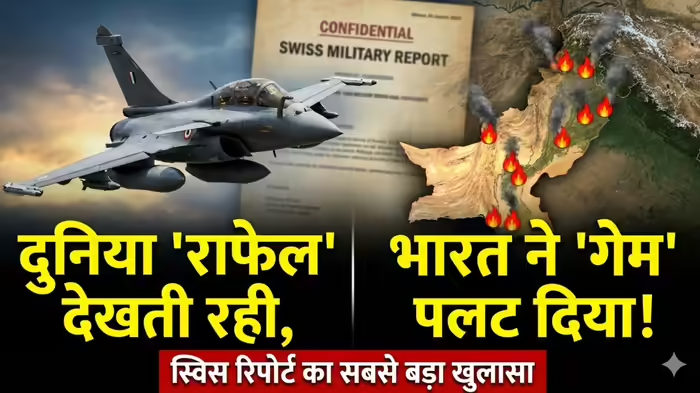
New Delhi, January 26, 2026: For the first time, a prominent Swiss military think tank, the Centre for Military History and Perspective Studies (CHPM), has released an in-depth analysis of Operation Sindoor, calling it a game-changing event in South Asian air power dynamics.
The report, authored by military historian Adrian Fontanelaz, examines the 88-hour India-Pakistan air conflict from May 7–10, 2025, describing it as the most comprehensive independent assessment of the operation so far.
According to the report, while international media initially focused on the loss of an Indian Rafale aircraft, this narrative obscured India’s decisive gains. India systematically neutralized Pakistan’s air defense infrastructure and strike capabilities, compelling Pakistan to seek a ceasefire after just four days of conflict.
The operation was launched in response to a deadly terrorist attack in Pahalgam, Jammu & Kashmir, linked to Pakistan-based groups. Indian Air Force strikes targeted Jaish-e-Mohammed and Lashkar-e-Taiba bases in Bahawalpur and Muridke. While Pakistan retaliated, India’s strategic use of SCALP and BrahMos missiles destroyed radar installations and missile systems, severely limiting Pakistan’s air operations.
The Swiss report also praised India’s integrated air defense network (IACCCS) and missile systems, including S-400 and Akash, for neutralizing retaliatory strikes. By May 10, Pakistan was unable to defend its airspace, forcing it to request a ceasefire.
CHPM concludes that Operation Sindoor signals a new strategic posture for India, showing that the country is prepared to hold Pakistan’s state apparatus accountable for cross-border terrorism rather than treating attacks solely as the work of non-state actors.
Discover more from SD NEWS agency
Subscribe to get the latest posts sent to your email.