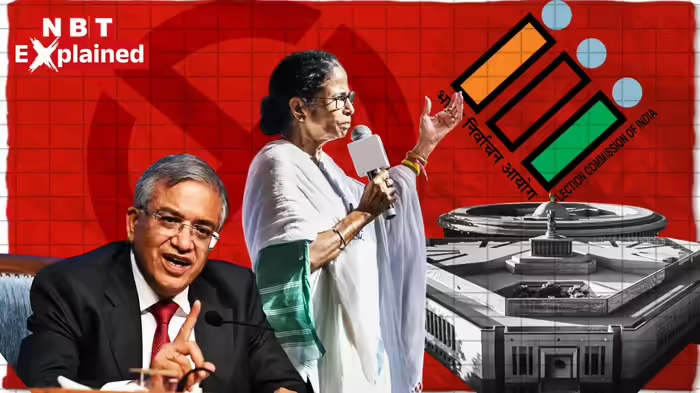
New Delhi: West Bengal Chief Minister Mamata Banerjee has intensified her political attack on Chief Election Commissioner (CEC) Gyanesh Kumar, signaling support for moves to remove him from office over the ongoing Special Intensive Revision (SIR) process. While Banerjee has acknowledged that the opposition lacks the numbers in Parliament, she says the effort is aimed at sending a political message.
Speaking after a meeting with Election Commission officials, Banerjee indicated she would support any move to initiate proceedings against the CEC, even if success is unlikely. Her remarks echo calls from sections of the opposition demanding accountability from the poll body.
Constitutional process for removing a CEC
The removal of a Chief Election Commissioner is governed by Article 324(5) of the Constitution, which provides the same protection as that granted to a Supreme Court judge. A CEC can only be removed on grounds of “proved misbehaviour or incapacity,” and through a parliamentary process identical to that used for removing a Supreme Court judge.
Under Article 124(4), a judge of the Supreme Court can be removed only after a motion is passed in both Houses of Parliament by a special majority — that is, a two-thirds majority of members present and voting, and a majority of the total membership of the House. Although the term “impeachment” is commonly used in public discourse, constitutionally it applies strictly to the President; removal of judges, the CEC, and the Comptroller and Auditor General follows a similar but technically distinct process.
The numbers problem for the opposition
Given the current parliamentary arithmetic, such a motion would face steep hurdles. In the 543-member Lok Sabha, the ruling NDA coalition holds about 293 seats. In the 245-member Rajya Sabha, it enjoys the support of roughly 134 members, along with backing from some neutral parties that have often voted with the government.
Because a removal motion requires a special majority in both Houses, the opposition — including the Trinamool Congress and Congress — does not have the numbers needed to carry it through. Banerjee herself has admitted that the effort is unlikely to succeed, but argues that placing the issue on record has political value.
For now, constitutional safeguards and parliamentary mathematics together make the removal of the CEC a remote possibility, underscoring the high threshold intentionally built into the system to protect the independence of key constitutional offices.
Discover more from SD NEWS agency
Subscribe to get the latest posts sent to your email.