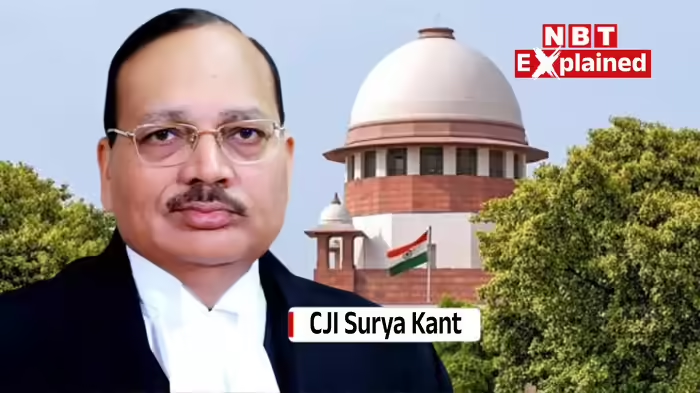
Chief Justice of India, Surya Kant, recently highlighted the pressing challenges facing India’s justice system: rising litigation costs and prolonged court proceedings, which hinder ordinary citizens from accessing justice. Speaking at a seminar organized by the Odisha High Court Bar Association on “Ensuring Justice for the Common Man: Strategies to Reduce Costs and Delays”, he emphasized that justice must be accessible, timely, and humane to uphold constitutional dignity.
The Story of an Elderly Farmer
Recalling an early experience from his legal career, CJI Surya Kant shared the story of an elderly farmer waiting outside the court until afternoon because his case was listed far down the schedule. When asked why he continued to wait despite the uncertainty, the farmer smiled faintly and said, “If I leave early, the other side will think I have given up.”
The Chief Justice stressed that for the farmer, the delay was not just a statistic—it gradually eroded his dignity. Excessive procedural delays and paperwork inflict real suffering, especially on the poor and vulnerable. Such delays, he noted, strike at the heart of Article 21, which guarantees the right to life and dignity. When justice becomes slow or costly, the promise of the law weakens, and public trust in the judiciary diminishes.
Restoring Faith Through Final Decisions
CJI Surya Kant noted that the backlog of pending cases is not confined to individual courts but is a systemic challenge. High courts burdened with old cases impact the functioning of lower courts. The Supreme Court is actively working to resolve long-pending matters, particularly those involving settled legal principles, to reduce uncertainty and restore confidence in the justice system. Final decisions at higher levels are crucial in strengthening faith across the judiciary.
Promoting Alternative Dispute Resolution (ADR)
The Chief Justice strongly advocated ADR mechanisms, especially mediation, as effective tools to reduce costs and delays. Drawing on his experience, he highlighted that mediation has successfully resolved family disputes, commercial disagreements, trademark conflicts, and even cross-border issues, whenever parties are willing to negotiate.
Curbing Unnecessary Litigation
CJI Surya Kant observed that ADR is still underutilized due to inadequate systems and institutional mindset. Government departments often file appeals out of fear rather than necessity. He emphasized the need for better training and accountability to prevent unnecessary litigation by the state.
Harnessing Technology for Justice
The Chief Justice also underscored the role of technology in improving judicial efficiency. Tools introduced during the COVID-19 pandemic—such as virtual hearings, e-filing, and online case tracking—have proven effective in reducing delays and making justice more accessible. Digital service of summons and electronic tracking of notices can save months otherwise lost to repeated adjournments. However, he cautioned against over-reliance on technology, especially in the face of deepfake and digital fraud threats.
Conclusion
CJI Surya Kant’s message was clear: justice must be people-centric, timely, and dignified. Reducing delays, embracing alternative dispute resolution, curbing unnecessary litigation, and judiciously leveraging technology are essential steps to restore public confidence in India’s judicial system.
Discover more from SD NEWS agency
Subscribe to get the latest posts sent to your email.