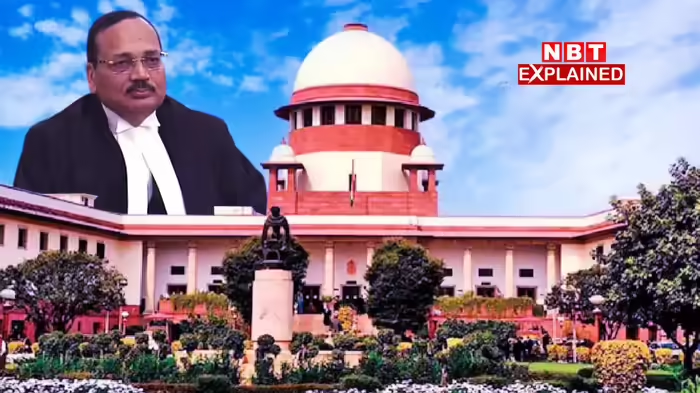
The Supreme Court has, in effect, rejected the gender handbook published in 2023 under the initiative of former Chief Justice of India D.Y. Chandrachud. The handbook, aimed at sensitizing judges and lawyers to gender-based stereotypes and abusive language, has been criticized by the current CJI Sunil Suryakant for being overly technical and “Harvard-oriented,” making it impractical for rape survivors and the general public.
CJI: Handbook Too Technical for Victims
A bench comprising CJI Suryakant, Justice Joymalya Bagchi, and Justice N.V. Anjari noted that the handbook provides forensic interpretations of sexual harassment issues, which are difficult for victims, their families, or laypersons to understand. While it suggested alternative language to replace commonly used stereotypes, the bench argued it would not serve its intended purpose for ordinary people.
Judicial Academy in Bhopal Tasked for Revision
The Supreme Court has referred the matter to the National Judicial Academy in Bhopal to re-evaluate the handbook. The Academy has been asked to prepare revised guidelines, consult legal experts, academicians, and senior advocates such as Shobha Gupta and H.S. Phoolka, and submit a report to the Supreme Court. CJI Suryakant emphasized that high court judges sitting in court do not benefit from “preaching” and should instead receive structured training at the Academy.
High Court Verdict Overturned
The bench also overturned the 17 March 2025 Allahabad High Court ruling that had controversially distinguished between preparation for a crime and attempt, dismissing cases where acts such as “grabbing breasts” or “loosening pajama strings” occurred. The Supreme Court had earlier taken suo motu cognizance of the insensitive ruling, which had sparked nationwide outrage.
Former CJI Chandrachud’s Intent
The handbook’s preface, authored by CJI Chandrachud, acknowledged prevalent stereotypes against women, some of which had historically influenced judicial decisions. The handbook aimed to highlight why such stereotypes are harmful and how they could distort legal outcomes—not to criticize past rulings, but to educate judges on unconscious bias.
Key Messages from the Handbook
The “Handbook on Combating Gender Stereotypes,” issued in August 2023, provided guidance for courts on addressing stereotypes in sexual violence and gender-related cases. Examples include:
- Stereotype: Women often make false sexual assault claims.
Reality: Women frequently lack family support and are not readily believed when reporting sexual violence. - Stereotype: Transgender people cannot be victims of rape.
Reality: Transgender individuals face sexual violence and abuse at higher rates. - Stereotype: Women are emotional and incapable of logical decisions.
Reality: Gender does not determine reasoning or decision-making capacity. - Stereotype: Women should do all household work.
Reality: People of any gender can perform household duties effectively. - Stereotype: Unmarried women cannot make important life decisions.
Reality: Marriage does not determine decision-making ability.
The Supreme Court’s decision underscores the need for practical, context-sensitive guidelines and structured judicial training to address gender bias effectively, rather than relying solely on theoretical handbooks.
Discover more from SD NEWS agency
Subscribe to get the latest posts sent to your email.