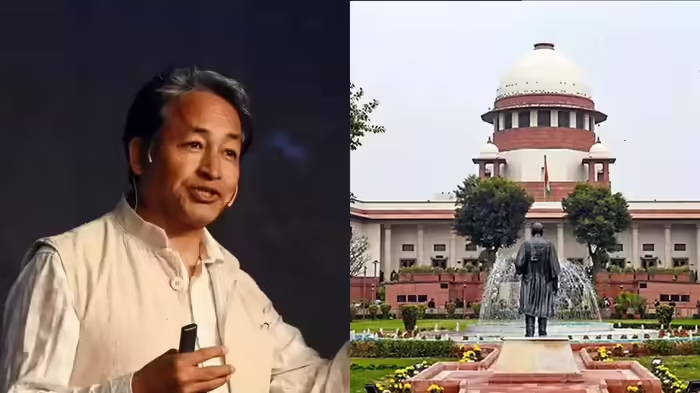
New Delhi: The Supreme Court hearing on the detention of Ladakh activist Sonam Wangchuk under the National Security Act (NSA) on Wednesday took an unexpected turn when the issue of Mahatma Gandhi arose in court. The Central Government, through Solicitor General Tushar Mehta, raised strong objections, urging that Wangchuk should not be portrayed or compared to Gandhi.
Background of the Case
Sonam Wangchuk is currently in preventive detention at Jodhpur Central Jail following allegations of inciting violence in Ladakh. His detention was challenged in court by his wife, Geetanjali Je Angmo, seeking his release.
During the hearing, the bench comprising Justices Arvind Kumar and P.B. Varale observed that the government may be over-interpreting Wangchuk’s statements. Solicitor General Mehta, however, objected to attempts to elevate Wangchuk’s image by likening him to Gandhi.
Court Discussion
The bench noted Wangchuk had warned against violent protests in a context that raised concerns about public order. However, the court emphasized the importance of reading his statements in full context. “You cannot cite a single sentence; the complete context must be considered,” the bench said. Wangchuk had described violent methods as “concerning”, not endorsing them.
When the bench quoted Wangchuk as saying, “Some people are abandoning Gandhi’s path of non-violence,” Mehta clarified that this should not imply Wangchuk is being Gandhi-like. He stressed that isolated lines cannot confer a Gandhian status, accusing Wangchuk of inciting public unrest under the guise of environmental activism.
The discussion also touched upon Gandhi’s final fast, highlighting that despite his call for peaceful action, posthumous communal disturbances occurred.
Centre’s Position
Solicitor General Mehta firmly requested the court:
“We should not glorify actions that are entirely anti-India. Sonam Wangchuk should not be compared to the Father of the Nation… We must avoid a headline tomorrow that the court equated him with Mahatma Gandhi.”
Mehta further objected to social media narratives exaggerating the issue, calling them “making a mountain out of a molehill”, though the bench clarified that questioning the matter in court was legitimate.
The Supreme Court has yet to pronounce its decision on Wangchuk’s detention, and the hearing underscores the sensitive balance between national security, activism, and public perception.
Discover more from SD NEWS agency
Subscribe to get the latest posts sent to your email.