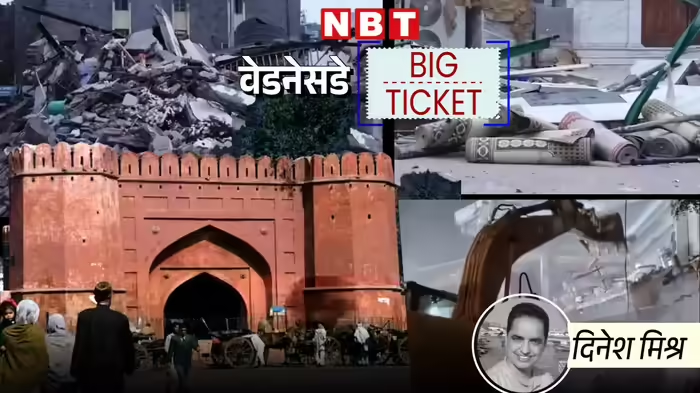
In the early hours of January 6th, 2026, bulldozers roared to life near the historic Turkman Gate in New Delhi, a Muslim-majority area. The demolition was carried out under the orders of the Delhi High Court, as part of an effort to remove illegal encroachments. This marked a significant moment in a long-standing history of forced evictions in the area, which dates back nearly five decades.
The Legacy of Sanjay Gandhi’s Decision
This event is reminiscent of a similar action that took place in February 1976 during the Emergency period, under the leadership of then-Prime Minister Indira Gandhi. At that time, her son, Sanjay Gandhi, visited Old Delhi and was alarmed by the encroachment around Turkman Gate, which obstructed the view of the Jama Masjid. Sanjay Gandhi decided that all illegal structures in the area should be demolished, a decision that would soon change the face of the locality.
In 1976, Sanjay Gandhi entrusted the task of clearing these encroachments to a trusted ally, Jagmohan, who was serving as the Vice-Chairman of the Delhi Development Authority (DDA) at the time. Jagmohan’s approach was to completely wipe out the illegal structures in the area.
The Bulldozer Action of 1976
According to reports from BBC, the demolition drive officially began in April 1976, when the first bulldozer arrived at Turkman Gate. Under Jagmohan’s orders, old buildings along Asaf Ali Road were razed, and nearby slums, including Kalma Mahal and Dujana House, were flattened. Thousands of residents were relocated to far-off rehabilitation colonies. The entire operation was carried out with a force of 16 bulldozers working day and night.
Jagmohan was determined to clear everything that stood in the way of a clear view from Turkman Gate to Jama Masjid, a project he took up without hesitation. The residents, displaced and agitated, were relocated to plots located 20 miles away across the Yamuna River.
The Controversial Dialogue
A delegation of locals went to meet Jagmohan, requesting that they be allowed to stay together in their community instead of being dispersed across distant areas. In response, Jagmohan famously said, “Do you think we are crazy enough to break one Pakistan only to let another one emerge? We will give you plots in Trilokpuri and Khichdipur, and you will have to go there just like the five lakh people we plan to resettle there. If you continue resisting demolition, the consequences will be severe.”
Protests and Police Action
Fast forward to 2026, as bulldozers returned to the area under a new government. The demolition was met with strong resistance from the locals. Around 5,000 people gathered near the Faiz-e-Ilahi Masjid to protest the removal of their homes. Despite facing lathi charges and tear gas, the protesters refused to disperse. As tensions escalated, the police resorted to firing shots in the air, an action that was later suppressed by the government due to the ongoing Emergency-like situation.
A Repeat of History
The current bulldozer action at Turkman Gate has brought back memories of the past, reminding the residents and the public of the turbulent period during the Emergency. While the names and faces may have changed, the practice of clearing the area of what are seen as “illegal encroachments” continues to raise questions about the fate of marginalized communities and the approach to urban development.
Discover more from SD NEWS agency
Subscribe to get the latest posts sent to your email.