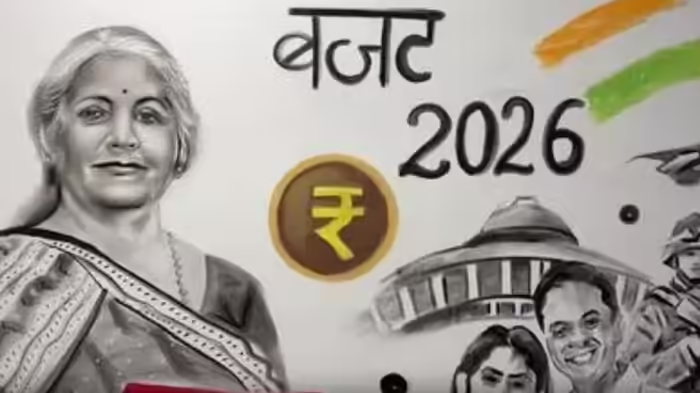
The government’s budget once again reflects a worrying trend: real spending on social sectors has steadily declined, and instead of compensating for this, allocations have been reduced. Cuts in spending on education, healthcare, water supply, and housing effectively push people’s living standards downward, with long-term consequences.
Data Reveals the Reality Behind the Claims
The government has allocated ₹1.4 lakh crore for healthcare—just 0.5% of GDP. Yet, the government itself has repeatedly acknowledged that spending should reach at least 2.5% of GDP, as recommended in the National Health Policy. India’s healthcare expenditure remains lower than neighboring countries and far below developed nations. Education fares no better, with only 0.6% of GDP allocated, despite the National Education Policy 2020 recommending a 6% target.
Budget numbers further highlight a troubling reality: actual spending consistently falls short of allocations. Most social welfare schemes reflect this underperformance. The Jal Jeevan Mission, for instance, received ₹67,000 crore last year but spent only ₹17,000 crore. Urban and rural housing schemes show similar inefficiencies, exposing failures at both administrative and financial levels.
Neglecting Employment-Generating Sectors
The neglect of social sectors becomes clearer when viewed alongside the tax structure, revealing the government’s priorities. A significant portion of government revenue comes from income tax paid by ordinary citizens (21% of revenue), while corporate taxes contribute just 18%. The government collects more from the general population but spends less on them. Repeated corporate tax cuts alongside rising income taxes have widened income inequality. According to the World Inequality Report 2026, the richest 10% in India capture 58% of the country’s total income, while 50% of the population share just 15%. Taxing high-income earners could reduce this gap, yet the budget suggests no serious steps in this direction.
Spending on employment-generating sectors is also inadequate. Agriculture supports 46% of India’s population, but allocations this year have increased by only ₹628 crore compared to last year—insufficient against the backdrop of rising inflation. Agricultural research funding remains stagnant, and pressures to open the sector to foreign competition make the budget’s neglect even more disappointing. Declining focus on employment is further illustrated by changes to the Mahatma Gandhi National Rural Employment Guarantee Act (MGNREGA), which has been transformed from a guaranteed scheme into a government-discretionary program. While allocations have not decreased, administrative discretion now determines its effectiveness.
Overall, the 2026 budget prioritizes corporate interests and the privileged, while essential social spending and employment-focused sectors continue to be sidelined—a worrying signal for India’s inclusive development.
Discover more from SD NEWS agency
Subscribe to get the latest posts sent to your email.