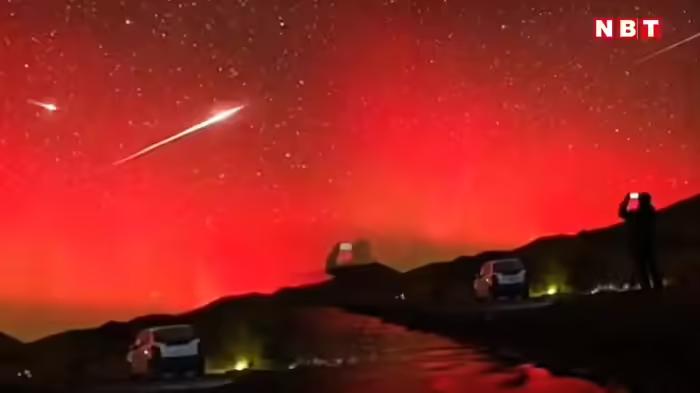
New Delhi: The night skies over Hanle in Ladakh on 19–20 January turned an eerie blood-red, leaving locals and observers both awestruck and alarmed. What appeared to be a northern lights-like spectacle was, in reality, a warning from the Sun—a powerful solar storm that poses risks to satellites, power grids, GPS systems, and other digital infrastructure in India.
A Rare and Intense Solar Event
This phenomenon was caused by the most intense solar radiation storm in the last 20 years, triggered by a massive X-class solar flare that erupted from the Sun on 18 January. The flare ejected a dense cloud of superheated plasma—a Coronal Mass Ejection (CME)—which traveled at a staggering speed of approximately 1,700 km per second and struck Earth’s magnetic field within 25 hours.
The impact disrupted the planet’s protective magnetosphere, creating a G4-level geomagnetic storm officially classified as “severe.” The interaction energized oxygen atoms at altitudes above 300 km, producing the deep red glow that illuminated the Ladakh skies. Unlike typical auroras, which appear green near the poles, this display occurred far south of the Arctic Circle, giving Hanle residents a rare glimpse of crimson auroral edges.
Visuals Go Viral, But Danger Looms
Social media exploded with images of the striking red skies, with many dubbing it “India’s northern lights.” While the phenomenon was visually mesmerizing, scientists caution that it was far from harmless. Such solar activity can disrupt communication systems, satellites—including India’s Aditya-L1 mission—and national power grids.
ISRO scientists warn that as the Sun approaches the peak of its roughly 11-year solar cycle, similar intense events are likely to become more frequent. Monitoring by space missions and satellites aims to predict such storms in advance, minimizing potential damage to critical infrastructure.
A Stunning Reminder of Cosmic Forces
The Ladakh skies offered a rare, breathtaking spectacle of nature’s power, reminding us that beauty in the cosmos can sometimes signal serious planetary risks. While residents marveled at the unusual auroral display, scientists continue to study the effects and prepare for future solar storms.
Discover more from SD NEWS agency
Subscribe to get the latest posts sent to your email.