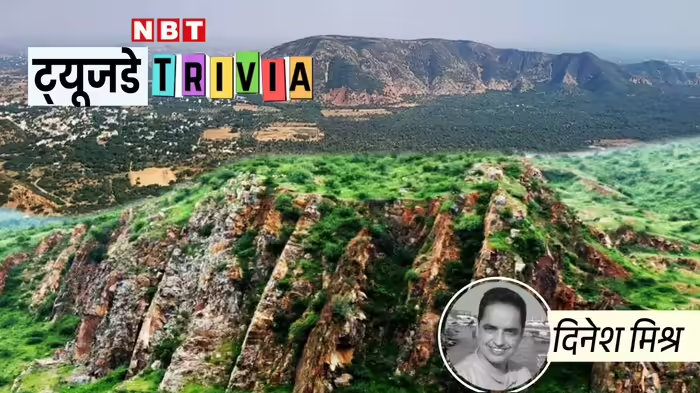
New Delhi: The Supreme Court’s recent ruling on the Aravalli Hills has raised concerns among environmentalists, sparking debates over how these ancient hills are defined and protected. The controversy centers on the Court’s decision to classify only land rising at least 100 meters (328 feet) above the surrounding terrain as part of the Aravalli range. While clusters of two or more such hills within 500 meters of each other will collectively form the Aravalli Hills, critics warn that this definition could leave many smaller but ecologically significant hills vulnerable to mining and construction.
Ecological Importance of the Aravallis
The Aravalli range, stretching over 650 kilometers from Delhi to Gujarat, is one of the oldest geological formations in India, dating back approximately 32 million years. According to Dr. Sana Rehman, Assistant Professor at Janaki Devi Memorial College, Delhi University, the Aravallis act as a natural barrier against the northward expansion of the Thar Desert, stabilize local microclimates, support biodiversity, and recharge groundwater systems. The range is also a source for rivers like the Chambal, Sabarmati, and Luni, and is rich in minerals such as sandstone, limestone, marble, granite, lead, zinc, copper, gold, and tungsten.
Supreme Court Ruling Sparks Concern
For nearly three decades, the Aravalli Hills have been under judicial scrutiny. In 2025, the Supreme Court approved a government committee’s definition that recognizes only hills rising 100 meters or more as Aravalli. The Forest Survey of India reports that of 12,081 hills across various states, only 1,048 (8.7%) meet this criterion. Experts argue that this threshold disregards smaller hills and valleys that are critical to the ecosystem.
Beyond Mining: Additional Threats
Environmentalists warn that even with mining restrictions, the Aravallis face other threats:
- Urbanization: Construction and colonies in lower areas bypassing the 100-meter hills.
- Road Building: Cutting ridges to build roads disrupts the natural landscape.
- Fragmentation of Ecosystems: Breaking continuous hill chains affects wildlife corridors.
- Destruction of Native Vegetation: Clearing flora in lower hills damages biodiversity.
Limitations of the Supreme Court Definition
The ruling does not protect:
- Low-height ridges below 100 meters
- Small hillocks crucial for the ecosystem
- Quartzite outcrops hidden underground
- Groundwater recharge zones at hill bases
Why This Matters for Delhi
Dr. Rehman notes that Delhi’s location historically depended on the Yamuna River and the Aravalli forests. Even hills as low as 40 meters can act as natural shields against the desert winds, conserve water, and support habitats. Limiting protection to only 100-meter-high hills could jeopardize the ecological integrity of the entire Aravalli range.
Government Position
Union Minister for Forests Bhupender Yadav stated that the 100-meter protection applies from the hill base upwards, and lands between two hills within 500 meters are also considered protected. However, experts argue that while mining may be restricted, this approach does not fully address the broader ecological vulnerabilities of the Aravallis.
Conclusion: A Range at Risk
The Aravalli Hills’ unique ecological, cultural, and geological significance demands protection beyond mere height measurements. Without safeguarding smaller hills, ridges, and valleys, the very existence of this ancient mountain range remains at risk, leaving a fragile ecosystem exposed to irreversible damage.