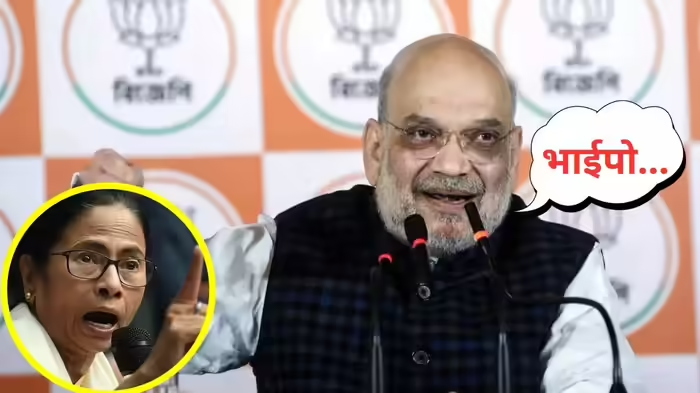
As the Bharatiya Janata Party (BJP) begins strategising for the upcoming 2026 West Bengal Assembly elections, Union Home Minister Amit Shah has taken aim at Chief Minister Mamata Banerjee and her nephew Abhishek Banerjee. During a public rally, Shah referred to Abhishek as “Bhaipo”, drawing attention to the family’s political influence in the state.
Political Context
At the rally, Shah accused the ruling Trinamool Congress (TMC) of enabling only the CM’s nephew to profit under the government, leaving ordinary citizens disadvantaged. He alleged that over the past 15 years, West Bengal has been plagued by corruption, fear, and illegal practices, and that central welfare schemes have fallen prey to local “toll syndicates.”
What ‘Bhaipo’ Means
In Bengali, ‘Bhaipo’ translates to nephew. Shah’s remark specifically pointed to Abhishek Banerjee, who is the nephew of CM Mamata Banerjee, affectionately called “Didi” by her supporters. The term has been employed politically to highlight Abhishek’s growing influence and the familial nature of governance in West Bengal.
Opposition parties have previously referred to Mamata Banerjee as “PC” (Aunty), while her government has been described as a “PC-Bhaipo government”, emphasising the duo’s family-centric leadership.
Historical Usage
The BJP had also used the term “Bhaipo” during the 2021 West Bengal Assembly elections to criticise the TMC. On 19 December 2021, Shah had addressed a rally in West Medinipur, accusing the CM of focusing solely on her nephew’s political ambitions, while neglecting the welfare of the state’s citizens.
Responding then, Abhishek Banerjee had remarked that BJP leaders frequently refer to him as “Bhaipo,” refusing to call him by his name, highlighting the political framing of his familial identity.
This renewed usage of ‘Bhaipo’ in 2025 signals BJP’s continuing strategy to challenge TMC’s family-centric leadership in West Bengal ahead of the 2026 elections.
Discover more from SD NEWS agency
Subscribe to get the latest posts sent to your email.