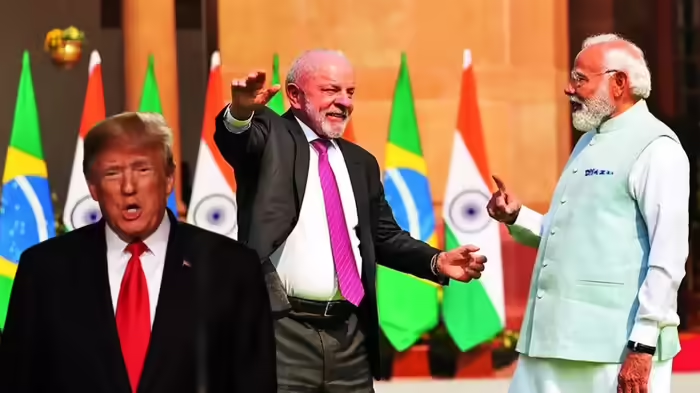
New Delhi | February 23, 2026 : After concluding a five-day visit to India, Brazilian President Luiz Inácio Lula da Silva is reportedly preparing for a possible trip to the United States next month — a visit that could carry a pointed diplomatic message for U.S. President Donald Trump on trade tariffs and global stability.
A Strategic India-Brazil Partnership
During his India tour, Lula held extensive talks with Prime Minister Narendra Modi, resulting in a significant bilateral agreement in the mining and minerals sector. The cooperation is expected to play a crucial role in the global race for critical minerals, essential for steel production, clean energy transitions, and high-technology manufacturing.
Brazil, the world’s largest producer of iron ore, possesses vast reserves of minerals critical for industrial development. The agreement is expected to strengthen India’s long-term steel security while deepening economic ties between the two emerging economies.
Prime Minister Modi expressed confidence that bilateral trade — currently valued at approximately $15 billion — could surpass $20 billion within five years. Both nations also agreed to collaborate in technology, innovation, digital public infrastructure, artificial intelligence, and semiconductors.
Partnership Based on Equality, Not Dominance
President Lula emphasized that India and Brazil share a partnership rooted in equality rather than hierarchy. In remarks widely interpreted as an indirect message to Western powers, Lula stated that engaging with India does not involve dealing with a “colonial master,” but rather with an equal partner.
He underscored that neither country seeks dominance over the other, highlighting a model of cooperation distinct from traditional power-driven alliances. Analysts believe this assertion subtly reflects Brazil’s discomfort with policies perceived as coercive or unilateral in global trade relations.
Tariffs and Trade Tensions
Both India and Brazil have been affected by the aggressive tariff policies introduced during President Trump’s second term, including duties reportedly reaching as high as 50 percent on select imports. Although the global trade environment has evolved since those initial measures, uncertainty continues to loom over international markets.
Lula’s recent remarks suggest a clear diplomatic stance ahead of his potential Washington visit. He warned that the world does not need further turbulence, calling instead for peace, predictability, and fair treatment among nations.
“I want to tell the American President that we do not want another Cold War. We do not want interference in other countries. We want equal treatment for all nations,” Lula said — a statement widely seen as a direct appeal to Trump to avoid discriminatory tariff measures.
A Subtle but Firm Diplomatic Signal
Political observers interpret Lula’s comments as more than advice — they view them as a caution against unilateral trade actions that could destabilize global supply chains. In recent months, even domestic legal challenges in the United States have questioned aspects of the administration’s tariff framework, adding further complexity to the debate.
As Lula prepares for a possible meeting at the White House, Brazil appears poised to advocate for balanced trade relations and a multipolar global order. For both India and Brazil — two influential voices of the Global South — the message is clear: cooperation must replace confrontation, and equality must define international partnerships.
Whether this diplomatic outreach will influence Washington’s trade stance remains to be seen, but Lula’s India visit has undeniably set the tone for a broader geopolitical conversation.
Discover more from SD NEWS agency
Subscribe to get the latest posts sent to your email.