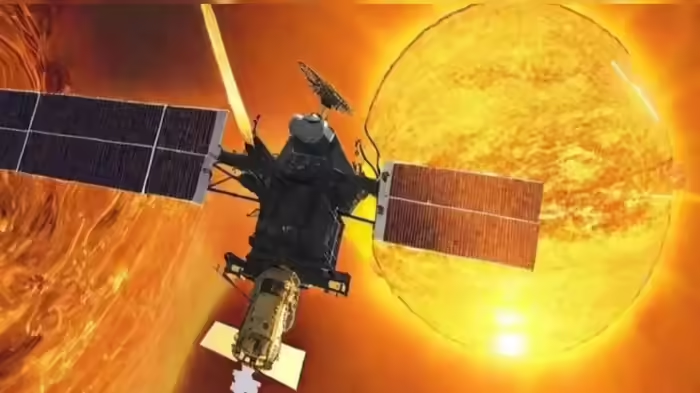
New Delhi: India’s solar observatory Aditya-L1 has played a pivotal role in understanding the strongest solar storm in decades, named the ‘Gannon Storm’. Precise magnetic field measurements from Aditya-L1 have helped scientists worldwide uncover why this geomagnetic storm, which hit Earth in May 2024, was unusually intense, improving our understanding of space weather and its impact on Earth.
According to the Indian Space Research Organisation (ISRO), Aditya-L1 collaborated with six American satellites, including NASA’s WIND mission, providing simultaneous measurements from multiple vantage points in space. This allowed researchers to study the rare storm in unprecedented detail.
Unraveling the Gannon Storm
The Gannon Storm resulted from a series of massive solar eruptions, known as Coronal Mass Ejections (CMEs)—enormous bubbles of hot plasma and magnetic energy launched from the Sun. When CMEs strike Earth, they can disrupt satellites, communication systems, GPS, and even power grids.
ISRO scientists discovered that the storm’s extreme behavior was caused by an unusual phenomenon called magnetic reconnection. Typically, a CME behaves like a twisted magnetic rope connecting with Earth’s magnetic shield. But during this event, two CMEs collided in space, causing the magnetic field lines inside one to break and reconnect in a new configuration. This sudden reorganization amplified the storm’s intensity far beyond expectations.
Satellites also recorded abrupt particle acceleration, confirming the occurrence of magnetic reconnection.
Mapping the Unprecedented Event
For the first time, researchers could observe a single extreme solar storm from multiple vantage points in space. Aditya-L1’s high-precision magnetic measurements enabled scientists to map the reconnection region, which spanned an area roughly 1.3 million km across, about 100 times the size of Earth.
This breakthrough is significant as it enhances our understanding of how solar storms evolve on their way to Earth, strengthening global space weather forecasting capabilities.
India’s Growing Leadership in Space Science
Launched in September 2023, Aditya-L1 is India’s first space-based solar mission. Its contribution to studying the Gannon Storm highlights India’s emerging leadership in global space science and its growing ability to predict and mitigate the effects of powerful solar storms.
With Aditya-L1’s observations, scientists now have better tools to understand and forecast extreme solar events, a critical step for safeguarding technology-dependent societies.
Discover more from SD NEWS agency
Subscribe to get the latest posts sent to your email.