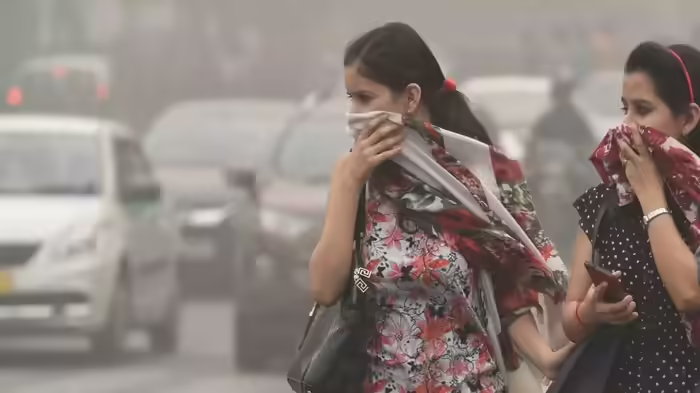
More than half of India’s cities have been struggling with air pollution for over five years. Yet, the National Clean Air Programme (NCAP) covers only a fraction of these, highlighting a significant gap in the country’s fight against air pollution. Experts emphasize the urgent need to expand NCAP’s scope and focus on pollutants like PM2.5.
Year-Round Pollution
According to a new analysis by the Centre for Research on Energy and Clean Air (CREA), only 4% of India’s most polluted cities fall under NCAP. Nearly half of the cities (44%) failed to meet PM2.5 standards consistently for five or more years. This indicates that air pollution is not a seasonal issue but a year-long challenge, driven by continuous emissions from transport, industry, and power plants.
CREA’s study, based on satellite data, examined 4,041 Indian cities from 2019 to 2024 (excluding the COVID year 2020). It found that 1,787 cities exceeded PM2.5 limits every year during this period, underscoring the persistent nature of the crisis.
NCAP Coverage Limited
Despite this alarming situation, the NCAP covers only 130 cities, addressing a small portion of the problem. Of these, only 67 cities overlap with the 1,787 highly polluted cities identified by CREA.
Experts Call for Broader Measures
Manoj Kumar, India Analyst at CREA, said, “The only way forward for India is to prioritize reducing PM2.5 and gaseous pollutants like SO2 and NO2, rather than just focusing on PM10. NCAP must broaden its scope and use these pollutants as benchmarks for action.”
Monitoring Gaps
The report also highlights gaps in monitoring infrastructure. Among the 130 NCAP cities, 28 still do not have Continuous Ambient Air Quality Monitoring Stations (CAAQMS). Of the 102 cities with monitoring stations, 100 report PM10 data coverage of 80% or more.
Funding Status
Since its inception, NCAP has received ₹13,410 crore in funding, of which ₹9,920 crore (74%) has already been spent. Approximately 68% of the funds have been used to tackle road dust, while 14% have gone towards controlling biomass burning.
Discover more from SD NEWS agency
Subscribe to get the latest posts sent to your email.