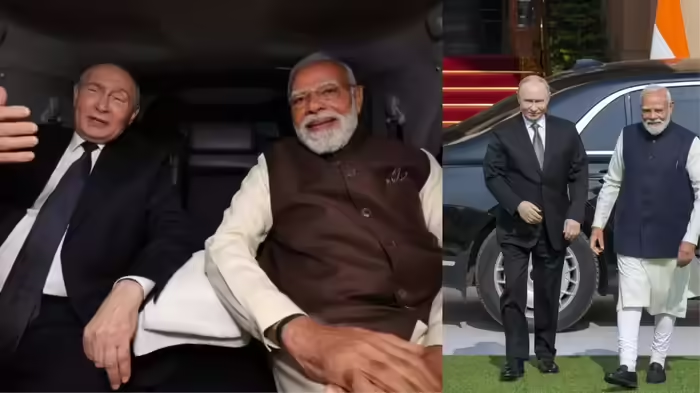
The year 2025 has emerged as one of the most defining and consequential periods of Prime Minister Narendra Modi’s leadership, marked by unprecedented diplomatic outreach, global recognition, and a sharp rise in India’s international stature. Through visits to 23 countries across Africa, West Asia, Europe and beyond, Prime Minister Modi reinforced India’s position as a confident, decisive and influential global power.
Expanding India’s Diplomatic Footprint
Prime Minister Modi’s extensive overseas engagements strengthened India’s diplomatic, economic and strategic partnerships. Relations with key regions—including Africa, the Gulf, Europe and the Indo-Pacific—were deepened, while ties with traditional partners such as the United Kingdom and the European Union were elevated through diversified strategic cooperation. Even complex relationships, including those with China, witnessed relative stabilisation during the year.
India’s outreach to the Maldives and several Global South nations underlined New Delhi’s commitment to inclusive growth, development cooperation and regional stability.
Standing Firm on Trade and National Interests
Amid global economic uncertainty and rising protectionism, Prime Minister Modi’s international standing grew significantly. While many nations yielded to pressure during former US President Donald Trump’s tariff confrontations, India remained resolute. Modi’s firm stance prioritised the interests of Indian farmers and small businesses, sending a clear message that India would not accept unfair trade practices or unequal economic arrangements.
A Fast-Growing Economic Power
India’s economy continued its strong upward trajectory in 2025. With GDP growth projected at around 7.3% for FY 2025–26 and an impressive 8.2% real growth recorded in the second quarter, India reinforced its position among the world’s fastest-growing major economies.
Key reforms—including GST rationalisation, rising consumer demand, and incentives for industry and manufacturing—fueled this momentum. Rapid advancements in digital infrastructure, semiconductors and artificial intelligence further highlighted India’s transformation into a technology-driven economy. The Peace Bill, 2025, was widely seen as a landmark reform reflecting institutional maturity.
Zero Tolerance Against Terrorism
India’s uncompromising stand against terrorism drew global attention. Following the April terror attack in Pahalgam, India launched Operation Sindoor and suspended the Indus Waters Treaty with Pakistan. Prime Minister Modi’s unequivocal statement—“blood and water cannot flow together”—became emblematic of India’s zero-tolerance policy on terrorism.
At the BRICS summit in July, for the first time, member nations collectively condemned terrorist attacks in Jammu and Kashmir. Similar strong messaging emerged from the SCO summit, reflecting growing international support for India’s position.
29 Nations Confer Highest Civilian Honours
India’s rising global prestige was reflected in the extraordinary recognition accorded to Prime Minister Modi. In 2025 alone, he received the highest civilian honours from 29 countries, including Barbados, Mauritius, Sri Lanka, Cyprus, Ghana, Trinidad and Tobago, Brazil, Namibia, Ethiopia and Oman.
Strategic trade diplomacy also gained momentum. Landmark agreements such as the India–UK CETA and India–Oman CEPA expanded India’s access to Western and Gulf markets. A free trade agreement with New Zealand and ongoing negotiations with the EU, Canada, Israel, Mexico and GCC nations reinforced global confidence in India as a reliable economic partner.
Addressing 18 Parliaments Worldwide
Prime Minister Modi also made history by addressing 18 foreign parliaments—the highest by any Indian leader. His speeches in countries such as Ghana, Trinidad and Tobago, Namibia and Ethiopia articulated India’s vision for a more equitable world order.
He strongly advocated the aspirations of the Global South, calling for better access to development finance, emerging technologies, and collective action on climate change and Sustainable Development Goals (SDGs).
Global Praise for Leadership and Statesmanship
World leaders across continents openly praised Prime Minister Modi’s leadership, integrity and personal diplomacy. Caribbean leaders described him as a stabilising global statesman, while Russian President Vladimir Putin remarked that India was “fortunate” to have such leadership.
Symbolic moments—such as Modi’s car diplomacy with President Putin and Jordan’s Crown Prince Hussein, Ethiopian Prime Minister Abiy Ahmed personally escorting him, and Bhutan’s King welcoming him on the roadside—highlighted the warmth and personal trust he shares with global leaders.
A Defining Year for India
Taken together, 2025 stands out as a watershed moment in India’s journey as a self-assured, emerging global power. Under Prime Minister Narendra Modi’s leadership, India projected confidence, defended its national interests, expanded its global influence and earned unprecedented respect on the world stage—cementing its role as a decisive force in shaping the 21st-century global order.