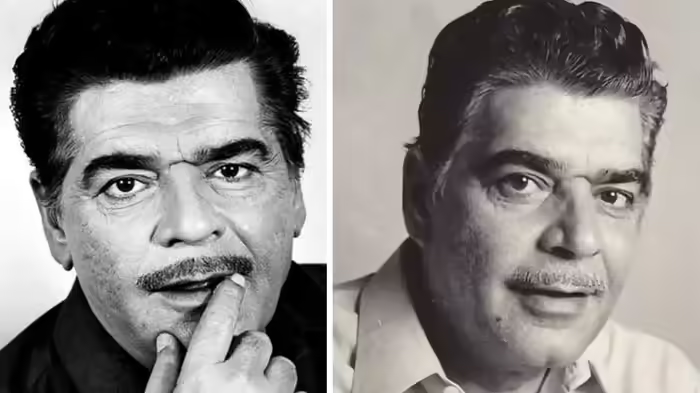
Veteran actor Ajit Khan, remembered as one of Bollywood’s most iconic and menacing villains, left an indelible mark on Indian cinema with his unique dialogue delivery and unforgettable screen presence. Even decades later, lines like “Mona Darling” continue to echo in popular culture. However, behind the suave villain image lay a life marked by intense struggle, resilience, and extraordinary turns of fate.
Born as Hamid Ali Khan, Ajit Khan’s early life was far removed from the glamour of cinema. His father worked as a driver for Mir Osman Ali Khan, the Nizam of Hyderabad, and wanted his son to pursue a respectable profession such as medicine or law. Ajit, however, was drawn to acting. Despite enrolling in college under parental pressure, his heart was never in academics. Eventually, he sold his books, left home, and came to Mumbai with dreams of becoming a film star.
The journey, however, was far from easy. Contrary to his expectations, work did not come easily, and there was a time when he did not even have a roof over his head. As revealed by his son Shehzad Khan in an interview, Ajit Khan spent some of his most difficult days living inside a cement pipe near a drain on Mohammed Ali Road. The area was controlled by local gangsters, but Ajit’s fearless nature ensured that no one dared trouble him after he stood up to them.
Ajit began his film career working as an extra, struggling for survival while chasing his passion. Though he eventually started getting lead roles, success continued to elude him. It was filmmaker Nanabhai Bhatt—father of Mahesh Bhatt and maternal grandfather of Alia Bhatt—who advised him to change his name. From Hamid Ali Khan, he became Ajit, a decision that proved to be a turning point. Soon after, he reinvented himself as a villain, a role that would define his legacy.
Interestingly, Ajit Khan also shared a personal connection with former Prime Minister P.V. Narasimha Rao. The two had studied in the same college, lived in the same hostel, and shared a bond during their younger days—an unexpected link between Indian cinema and politics.
Ajit Khan’s personal life was equally eventful. He married three times. His first marriage, a love match with an Anglo-Indian Christian woman, ended in divorce. His second marriage to Shahida was stable and blessed with three sons, but her untimely death left him devastated. He later remarried and had two more sons, including actor Shehzad Khan.
Ajit Khan passed away in 1998 following a heart attack, leaving the film industry in shock. Over a career spanning four decades, he appeared in more than 200 films, portraying villainous roles in nearly 57 films during the 1970s alone. His performances in classics such as Zanjeer, Yaadon Ki Baaraat, Mughal-e-Azam, Naya Daur, and Nastik cemented his place in cinematic history.
On his 104th birth anniversary, Ajit Khan is remembered not just as Bollywood’s quintessential villain, but as a symbol of grit, transformation, and enduring legacy—an artist who rose from the harshest struggles to become an unforgettable icon of Indian cinema.
Discover more from SD NEWS agency
Subscribe to get the latest posts sent to your email.