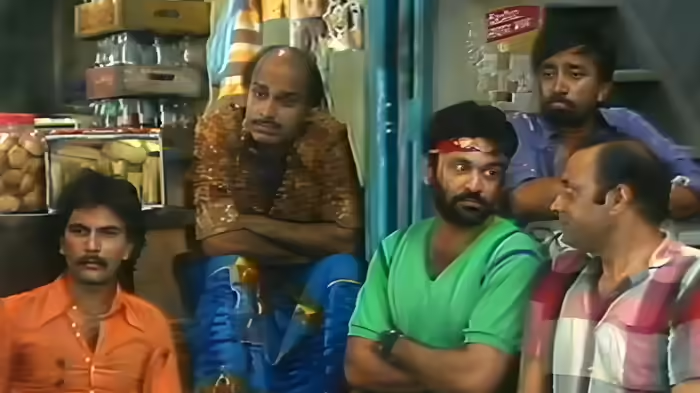
In the 1980s, when Indian television was dominated by mythological epics like Ramayan and Mahabharat, a quietly revolutionary series emerged on Doordarshan that shifted the focus from gods and palaces to street corners and ordinary lives. That show was Nukkad, a 39-year-old television classic that continues to resonate with audiences and holds an impressive 8.4 rating on IMDb.
Airing between 1986 and 1987, Nukkad was created by celebrated filmmakers Saeed Akhtar Mirza and Kundan Shah. With just 40 episodes and 27 memorable characters, the series captured the everyday struggles, humour, and humanity of people living on the margins of urban India.
Stories from the Streets
Set in Mumbai, Nukkad portrayed lives often ignored in mainstream narratives — a tea seller, a paan vendor, a sanitation worker, a beggar, a cycle mechanic, a drunkard, domestic help, and small shopkeepers. These were people most passers-by overlooked, yet the series placed them at the centre of its storytelling, giving them dignity, voice, and emotional depth.
Unlike typical social dramas, Nukkad chose a light-hearted, humane tone to depict poverty and struggle, making the characters relatable rather than preachy. This approach helped the show connect deeply with middle-class audiences, who began to reflect on the invisible lives around them.
Modest Set, Lasting Impact
The entire set of Nukkad was built inside Rajkamal Studio, Mumbai, within a modest 600-square-foot space. Art director Jayant Bhinde designed the set after studying over 1,300 photographs of Mumbai’s street corners. At a time when budgets were minimal, the show was made at a cost of just ₹1.25 lakh, yet it achieved an authenticity rarely matched even today.
Iconic locations such as a small hotel, an electrical shop, a sari store, and Gupta Ji’s shop were all recreated on set, forming a microcosm of urban life.
Initially Criticised, Eventually Celebrated
When Nukkad first aired, it faced criticism for being “left-leaning” or politically inclined. However, as episodes progressed, audiences embraced its honest portrayal of everyday conflicts — from neighbourhood disputes and friendly cricket matches to grief, death, and acceptance in a fast-changing world.
The show’s title song, written by Imtiaz Hussain and composed by Kuldeep Singh, became iconic, echoing the philosophy of diverse lives and destinies coexisting at a single street corner.
A Launchpad for Theatre Talent
Most of Nukkad’s cast came from National School of Drama and Prithvi Theatre, and the show became their first full-time television assignment. Actors like Dilip Dhawan, Rama Vij, Pawan Malhotra, Sangeeta Naik, Avtar Gill, and others found nationwide recognition through the series.
Characters such as Khopdi, Kaderbhai, and Ghanshu the beggar became household names, remembered fondly even decades later. Several actors returned in the 1993 sequel, Naya Nukkad.
A Show Ahead of Its Time
What made Nukkad truly special was its ability to portray poor, middle-class, and upper-middle-class lives together, without hierarchy or judgement — from Bhendi Bazaar and Parel to Shivaji Park and Mahim. It reminded viewers that a single street corner could reflect the entire social spectrum of India.
Nearly four decades later, Nukkad remains a benchmark for realistic storytelling on Indian television — a reminder that powerful stories do not need grand sets or spectacle, only truth, empathy, and human connection.
Discover more from SD NEWS agency
Subscribe to get the latest posts sent to your email.