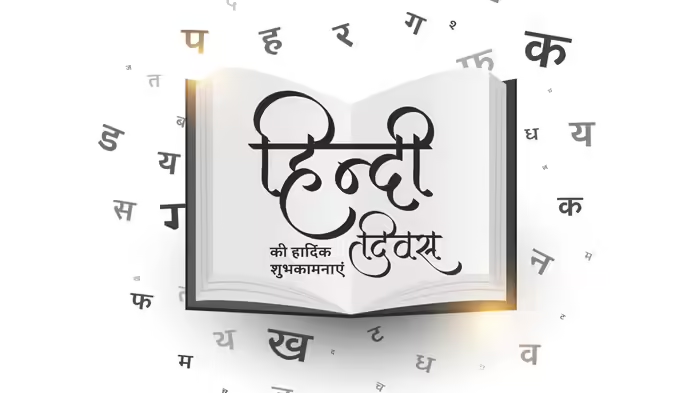
World Hindi Day 2026 is observed every year on 10 January to celebrate the global reach and significance of the Hindi language. Despite being the third most spoken language in the world, after English and Mandarin, Hindi is not India’s national language.
Hindi: Official Language, Not National Language
India’s Constitution under Part 17, Article 343(1) declares Hindi as the official language of the country, written in the Devanagari script, but it does not designate Hindi as the national language. This distinction is important to understand, given India’s rich linguistic diversity.
While nearly 43% of India’s population speaks Hindi, the country is home to many other languages, and a significant number of people neither speak nor understand Hindi. India recognizes and respects this linguistic diversity, ensuring freedom to speak, read, and write in one’s mother tongue.
Legal Background of Hindi in India
After India gained independence, legislation was introduced to define the status of Hindi. Key figures such as Kanhaiyalal Maniklal Munshi and N. G. Ayyangar were tasked with drafting language laws, while Dr. B. R. Ambedkar chaired the committee.
On 14 September 1949, under Articles 343 and 351 of the Constitution, Hindi was declared the official language of India. Subsequently, 14 September began being observed as National Hindi Day.
Article 343(1) explicitly states that Hindi in Devanagari script will be used for official purposes. Initially, this was applied for 15 years, but even after this period, much of official work continued in English. Consequently, other languages were also given official recognition.
Why World Hindi Day Is Celebrated on 10 January
Post-independence, the question arose: should Hindi remain limited to India or gain recognition internationally? With English emerging as a global language, and Spanish, French, and Chinese gaining international prominence, Hindi needed a global platform.
On 10 January 1975, India’s then Prime Minister Indira Gandhi organized the first World Hindi Conference, attended by Hindi scholars from over 30 countries. Discussions focused on promoting Hindi globally through education, research institutes, and international conferences.
In 2006, remembering this historic event, Prime Minister Dr. Manmohan Singh officially declared 10 January as World Hindi Day, and since then, it has been celebrated annually to honor the language’s global significance.
Hindi may not be India’s national language, but it continues to thrive globally and culturally, reflecting the country’s linguistic richness and the language’s growing international stature.
Discover more from SD NEWS agency
Subscribe to get the latest posts sent to your email.