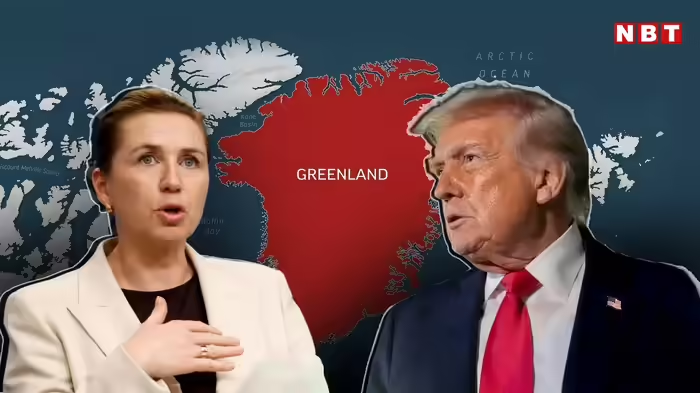
Greenland, the world’s largest island, enjoys self-rule but remains under Danish control for foreign affairs, defense, and economic matters. Its strategic importance has recently caught the attention of the United States, raising eyebrows across Europe and the world.
Greenland’s Status and Location
Greenland has been part of Denmark for over 300 years and lies in the North Atlantic Ocean. In 1979, Denmark granted Greenland autonomous powers, allowing it to manage internal affairs while Denmark retains control over defense, foreign policy, and economic oversight. As a NATO member, Denmark extends security guarantees to Greenland.
Home to around 57,000 people, Greenland’s population is predominantly indigenous (88%), followed by Danish, Nordic, and other international residents. With a GDP of $3.33 billion and a per capita income of $58,499, Greenland is a wealthy and strategically positioned territory.
Why the U.S. Wants Greenland
Former U.S. President Donald Trump repeatedly emphasized the strategic and security importance of Greenland, suggesting that if the U.S. did not assert its interest, rival powers like Russia and China might. NATO allies have warned that any military attempt to seize Greenland could jeopardize decades-old transatlantic alliances. Below are three major reasons why the U.S. is keen on Greenland:
1. National Security
Greenland lies between Europe and North America and is close to the Arctic and North Atlantic Oceans, making it vital for military and security strategy. The region has seen increased activity from China and Russia, prompting U.S. concern. The U.S. already maintains a military base on the island, but full control would allow the U.S. to secure air, sea, and even space dominance over this critical region.
2. Economic Gains
Greenland’s economic potential goes beyond military strategy. Melting ice due to climate change is opening access to rare minerals like lithium, essential for electric vehicles and batteries. The U.S., heavily reliant on China for lithium, sees Greenland as a way to diversify its supply. Additionally, the island has oil and gas reserves, further enhancing its economic value.
3. New Trade Routes
Approximately 80% of Greenland is covered by ice, but rising temperatures are accelerating ice melt, opening Arctic shipping routes. The Northeast and Northwest passages could significantly shorten trade between Asia, Europe, and North America. U.S. control over Greenland would allow strategic influence over these emerging international maritime routes, positioning the island as a future global trade hub.
With these factors combined, Greenland is emerging as one of the most strategically important territories of the 21st century, drawing the keen interest of the United States on multiple fronts—security, economy, and trade.
Discover more from SD NEWS agency
Subscribe to get the latest posts sent to your email.