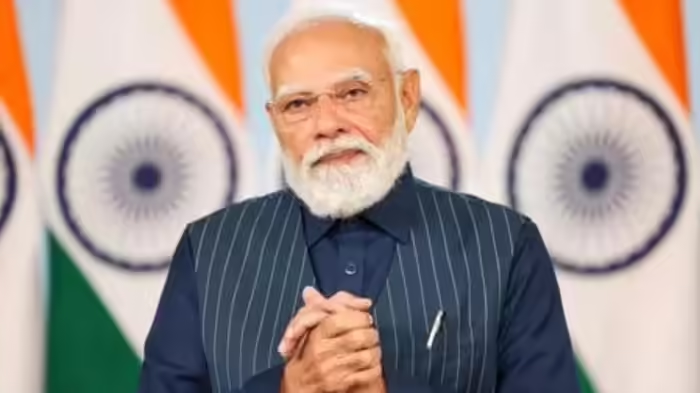
Prime Minister Narendra Modi has repeatedly called upon the nation to free itself from what he describes as the “Macaulay mindset” — a colonial-era way of thinking imposed on India nearly two centuries ago. According to the government, the National Education Policy (NEP) is the key instrument through which this long-standing legacy can be dismantled.
Union Education Minister Dharmendra Pradhan reiterated this vision on Saturday, stating that Prime Minister Modi is determined to liberate India’s younger generation from the Macaulay mindset, and that NEP 2020, now in its sixth year of implementation, will bring about a transformative shift in the country’s education system.
Who Was Thomas Babington Macaulay?
Thomas Babington Macaulay, commonly known as Lord Macaulay, was a British historian and politician who served as a legal member of the Governor-General’s Council in India in 1834. He is widely regarded as the architect of English-language education in colonial India.
On February 2, 1835, Macaulay authored the infamous “Minute on Indian Education”, which was later accepted by Governor-General Lord William Bentinck. This document fundamentally altered India’s education policy and laid the foundation for the British education system in the country.
Macaulay’s stated objective was to create a class of people who would be “Indian in blood and colour, but English in tastes, opinions, morals and intellect,” thereby serving as intermediaries between the British rulers and the Indian masses.
How India’s Education System Was Reshaped
The acceptance of Macaulay’s Minute led to the decline of traditional Indian education systems such as gurukuls and pathshalas. Institutions teaching in Sanskrit and other classical Indian languages were denied recognition, while English-medium schools and Western curricula were actively promoted.
Macaulay argued that English was more “useful” and “practical” than Indian languages such as Sanskrit or Arabic. This belief resulted in a systemic shift that prioritised Western knowledge systems over India’s indigenous intellectual traditions.
What Is the ‘Macaulay Mindset’?
The term “Macaulay mindset” refers to the lingering psychological and cultural impact of colonial education policies. It is rooted in Macaulay’s Downward Filtration Theory, which advocated educating only a small section of the elite so that Western ideas could gradually trickle down to the rest of society.
In contemporary terms, this mindset manifests as:
- Viewing English as a measure of intelligence or superiority
- Undervaluing Indian languages, culture, and traditional knowledge systems
- Considering Indian history and philosophy as backward or irrelevant
- Placing Western thought above indigenous perspectives
According to the Prime Minister, this colonial legacy continues to influence India’s education system, administration, and social attitudes even decades after independence.
NEP as the Tool for Decolonising Education
Prime Minister Modi has consistently described the National Education Policy, announced on July 29, 2020, as a decisive step towards dismantling the Macaulay mindset. The policy introduces wide-ranging reforms in school, higher, and technical education, with a strong emphasis on mother-tongue instruction, skill-based learning, and holistic development.
Education Minister Dharmendra Pradhan said the NEP aims to empower India’s youth by providing education rooted in local languages, Indian values, and practical skills. “India is a young nation. Our responsibility is not just to create job-seekers, but job-creators,” he said, adding that NEP is aligned with this vision.
PM Modi’s Call to the Nation
Addressing citizens in New Delhi on November 17, Prime Minister Modi urged the country to take a collective pledge to free itself from the colonial mindset imposed by Macaulay. He noted that by 2035, it will be 200 years since Macaulay’s education policy reshaped India’s intellectual landscape.
“We must resolve that in the coming decade, India will free itself from the mentality of intellectual slavery imposed during colonial rule,” the Prime Minister said.
As the debate around education reforms continues, the government maintains that breaking free from the Macaulay mindset is essential for reclaiming India’s cultural confidence and shaping a self-reliant, future-ready generation.
Discover more from SD NEWS agency
Subscribe to get the latest posts sent to your email.