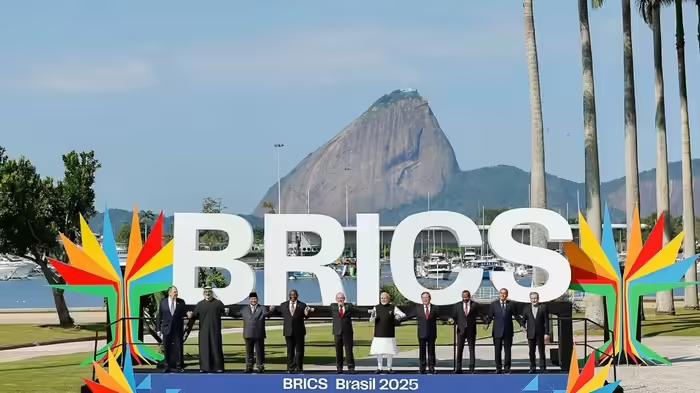
India is set to assume the BRICS presidency on January 1, 2026—at a time when tensions with the United States are running high. The U.S. has already indicated plans to impose tariffs on BRICS nations, making India’s leadership all the more significant in the global political arena.
For UPSC, SSC, and other competitive exam aspirants, understanding BRICS is essential, as questions on the group frequently appear in both written exams and interviews. Here’s everything you need to know about BRICS—its origins, members, and functions.
What is BRICS?
BRICS is a coalition of 11 countries: Brazil, Russia, India, China, South Africa, Saudi Arabia, Egypt, the United Arab Emirates (UAE), Ethiopia, Indonesia, and Iran. The group acts as a political and diplomatic coordination platform for Global South nations. Its main objectives include strengthening economic, political, and social cooperation among member states and enhancing their influence in international governance.
BRICS also seeks to reform global institutions such as the United Nations, International Monetary Fund (IMF), World Bank, and World Trade Organization (WTO) to ensure equity and efficiency. The group represents over 40% of the world’s population, and its members collectively hold some of the largest economies globally. Trade among BRICS nations exceeds $1 trillion, highlighting the group’s growing global significance.
The Origin of BRICS
The term “BRIC” was first coined in 2001 by Jim O’Neill, an economist at Goldman Sachs, to recognize the rapid economic growth of Brazil, Russia, India, and China. Despite differing political ideologies, these countries’ leaders collaborated to form a platform for coordination.
Initially, meetings were limited to foreign ministers. The first BRICS foreign ministers’ meeting took place in New York during the 2006 UN General Assembly. The inaugural BRICS summit for national leaders was held in 2009 in Yekaterinburg, Russia. In 2010, South Africa joined the group, adding the “S” to BRICS.
Who Are the Members of BRICS?
Currently, BRICS has 11 member states. The original five are Brazil, Russia, India, China, and South Africa. Between 2024–25, six new members joined: Egypt, Ethiopia, Indonesia, Iran, Saudi Arabia, and the UAE. Additionally, Belarus, Bolivia, Cuba, Kazakhstan, Malaysia, Nigeria, Thailand, Uganda, and Uzbekistan are partner countries. The expansion was formalized during the Johannesburg Declaration of August 2023.
What Does BRICS Do?
BRICS leaders hold annual summits, with one member country hosting and chairing the group each year. Decisions are made by consensus, and the group functions largely as an informal organization, without a fixed charter, secretariat, or central fund.
The group’s core objectives include:
- Advocating for increased participation of member states in global institutions.
- Coordinating economic policies and reducing dependence on the U.S. dollar.
- Developing an independent financial system to operate alongside the World Bank and IMF.
How Do Western Nations View BRICS?
Western nations have historically underestimated BRICS. In 2024, U.S. President Joe Biden stated that the U.S. does not view BRICS as a geopolitical rival and rejected its plan to reduce reliance on the dollar. Experts note that internal conflicts among BRICS members sometimes hinder a unified global strategy, limiting the group’s immediate threat to Western economies.
However, European leaders have warned that anti-Western sentiments are rising globally. Many low-income countries are seeking alternative platforms, and BRICS is increasingly seen as one such option. Even former U.S. President Donald Trump claimed in February 2025 that BRICS is “defunct,” yet threatened 100% tariffs on BRICS nations later that year.
With India taking the helm from January 1, 2026, the world will closely watch how the BRICS agenda unfolds under its leadership.
Discover more from SD NEWS agency
Subscribe to get the latest posts sent to your email.