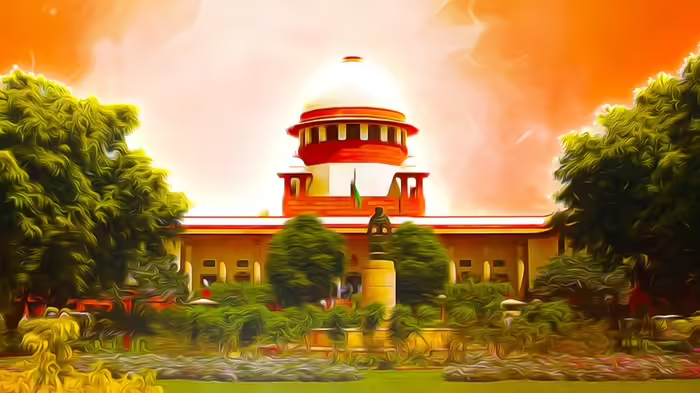
The Supreme Court of India has exercised its special powers under Article 142 and reinstated the University Grants Commission (UGC) 2012 rules on an interim basis. This move comes after the Court put a hold on the new UGC Equity Regulations 2026, citing concerns over vague definitions in Clause 3C related to caste-based discrimination, which could potentially be misused in the future.
What the Supreme Court Decided
Until further orders, universities and colleges across India will continue to follow the “Promotion of Equity in Higher Educational Institutions, Regulations 2012”. While the 2012 rules initially excluded OBCs, the new 2026 regulations had included them, creating additional controversy. According to the Ministry of Education, students from OBC, SC, and ST categories now account for 61% of total enrollment.
Key Provisions of UGC 2012 Rules
The UGC introduced these rules on 17 September 2012 to promote equality and prevent discrimination in higher education institutions. Key provisions included:
- Establishment of Equity Cells (EOC):
- Every university and college was advised to set up an Equal Opportunity Cell (EOC).
- The EOC’s role was to address complaints from SC and ST students and create an environment of equality on campus.
- These guidelines were advisory and not legally binding.
- Scope of Rules:
- Initially applicable only to SC and ST students; OBCs were not included.
- Covered discrimination based on caste, religion, language, ethnicity, gender, and disability, though compliance was advisory.
- Complaint Mechanism:
- Students or their guardians could file written complaints regarding discrimination or harassment, whether inside or outside the campus.
- Complaints were to be addressed by an Anti-Discrimination Officer through a transparent process.
- Higher education institutions were advised to publish details of the complaint process on their websites.
- Penalties and Action:
- EOCs could hear complaints, but the 2012 rules were not legally enforceable.
- The Anti-Discrimination Officer would investigate, and action could be taken for students under UGC 2009 grading rules, and for staff under service rules.
- The establishment of EOCs was discretionary; institutions could decide whether or not to form them or act on complaints.
- Appeal Provision:
- Any aggrieved party could appeal against an order from the Anti-Discrimination Officer to the head of the institution within 90 days.
- Even after 90 days, the head of the institution could consider the appeal if there was a valid reason for delay.
Implications
By reinstating the 2012 rules, the Supreme Court has temporarily paused the implementation of 2026 regulations. Universities and colleges will continue to follow existing equity frameworks, ensuring a standard mechanism for addressing discrimination against SC/ST students, while the inclusion of OBCs in the 2026 rules remains under judicial review.
Discover more from SD NEWS agency
Subscribe to get the latest posts sent to your email.