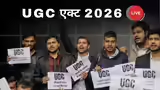
The Supreme Court of India has temporarily stayed the implementation of the University Grants Commission (UGC) Act 2026, amid nationwide protests and concerns over its caste-based admission provisions. The court noted that several provisions of the new UGC regulations are vague and open to misuse, and sought clarification from experts. Meanwhile, universities and colleges will continue to follow the 2012 UGC regulations until further notice. The next hearing is scheduled for 19 March 2026.
The UGC Equity Act 2026 has triggered widespread debate across states such as Delhi, Uttar Pradesh, Rajasthan, and Bihar. Critics argue that the rules are one-sided, and several SC-ST-OBC student organizations have actively protested against it. In Bareilly, city magistrate Anlakar Agnihotri resigned, describing the new rules as a “black law.” Meanwhile, organizations representing forward castes have threatened intensified protests.
Supreme Court Raises Key Questions
During the hearing, the Chief Justice of India (CJI) highlighted the lack of clarity in the provisions. One notable question concerned regional student admissions:
“If a student from South India takes admission in a North Indian institution, or vice versa, and faces mockery, humiliation, or insulting remarks, but the caste identities of both the victim and the perpetrator are unknown, will Regulation 3(e) address this situation?”
The CJI also observed that economic prosperity within SC communities raises questions about the applicability of caste-based protections. He asked whether India is moving backwards from the goal of a caste-neutral society.
Legal Challenges and Protests
So far, three petitions challenging the UGC 2026 rules have been filed in the Supreme Court, arguing that the caste-based protections are not fully inclusive. The 2012 regulations, which were merely advisory, focused mainly on SC and ST students, while the new 2026 Act also includes OBC students and extends protection against discrimination on the grounds of religion, language, gender, and disability.
Formation of a High-Level Committee
The Supreme Court suggested the creation of a committee of legal experts to review and recommend necessary changes in the UGC regulations. However, the exact composition and mandate of this committee are yet to be finalized. The committee will review:
- The 2012 UGC regulations,
- The draft of the 2026 rules, and
- Proposals for amendments and final regulations.
Government and Political Response
Several leaders have welcomed the Supreme Court’s intervention:
- TMC MP Kalyan Banerjee called the SC stay a “necessary and correct step” and criticized the 2026 rules as unconstitutional.
- BSP Chief Mayawati also supported the stay on the new regulations.
- Union Minister Giriraj Singh emphasized that the government under PM Narendra Modi has always worked for the welfare of all citizens without discrimination and highlighted the commitment to social harmony.
What is UGC?
The University Grants Commission (UGC) is responsible for:
- Promoting higher education in India,
- Ensuring recognition of degrees, diplomas, and certificates,
- Setting and maintaining standards in teaching, examination, and research,
- Formulating education policies and regulations,
- Coordinating between central and state governments, and
- Initiating quality development measures in higher education institutes.
Next Steps
The Supreme Court’s stay ensures that the 2012 UGC regulations remain in force for the time being. The new rules under the UGC Act 2026 will remain on hold until the next hearing and the recommendations of the expert committee.
Discover more from SD NEWS agency
Subscribe to get the latest posts sent to your email.