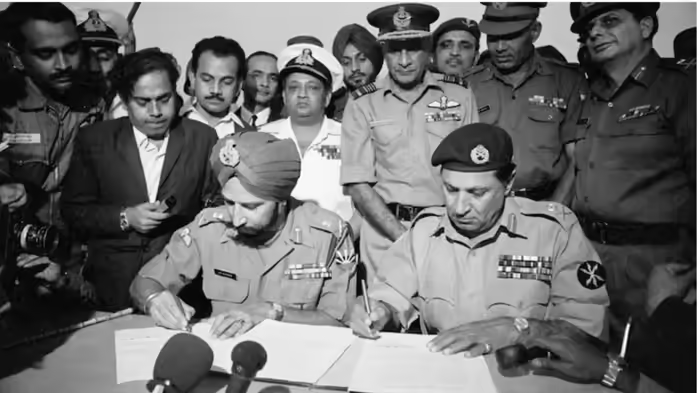
The Bangladesh Liberation War of 1971 was a defining moment in South Asian history. India played a pivotal role in the emergence of an independent Bangladesh, supporting the people of East Pakistan both strategically and militarily. Indian forces intervened, and 93,000 Pakistani soldiers eventually surrendered, paving the way for the creation of a free Bangladesh.
The Roots of Conflict: Years of Struggle
Pakistan, formed in 1947, was divided into West and East regions with distinct languages, cultures, and identities. While Urdu was spoken in West Pakistan, Bengali was the main language in East Pakistan. In March 1948, Muhammad Ali Jinnah declared Urdu as the sole official language, sparking significant tension. Cultural and political differences, coupled with unequal distribution of power and resources, fueled resentment in the eastern wing over the decades.
1970 Elections and Rising Protests
In the 1970 general elections, Sheikh Mujibur Rahman’s Awami League won a majority in East Pakistan, but political power was denied to the elected representatives. This led to massive protests and unrest in the region.
Operation Searchlight and the Outbreak of the Liberation War
On March 25, 1971, the Pakistani military launched Operation Searchlight, arresting Sheikh Mujibur Rahman and transferring him to West Pakistan. The operation led to widespread killings and atrocities across Dhaka and East Bengal, prompting millions of Bengalis to flee to India. By May 1971, India was hosting 1.5 million refugees, a number that rose to around 10 million by December. India established 825 refugee camps across seven states, including 19 central camps accommodating up to 50,000 people each. The refugee crisis placed a heavy strain on India’s economy.
India Joins the War
India supported Sheikh Mujibur Rahman’s independence movement and helped establish a provisional government in Kolkata. The Mukti Bahini, a liberation army, fought against Pakistani forces. On December 3, 1971, Pakistan launched airstrikes on Indian airbases, prompting India to formally enter the war.
Operation Trident and Pakistan’s Surrender
India’s military launched decisive operations alongside the Mukti Bahini. Operation Trident, initiated on December 4, targeted Pakistani forces in retaliation for the attacks. After just 14 days, on December 16, 1971, Lieutenant General A.K. Niazi of Pakistan surrendered to Indian Lieutenant General Jagjit Singh Arora, along with 93,000 troops.
Birth of a New Nation
Following Pakistan’s surrender, India unilaterally declared a ceasefire. Bangladesh emerged as an independent nation, with Sheikh Mujibur Rahman as its first Prime Minister. India’s strategic, humanitarian, and military support was instrumental in achieving Bangladesh’s freedom.
Discover more from SD NEWS agency
Subscribe to get the latest posts sent to your email.