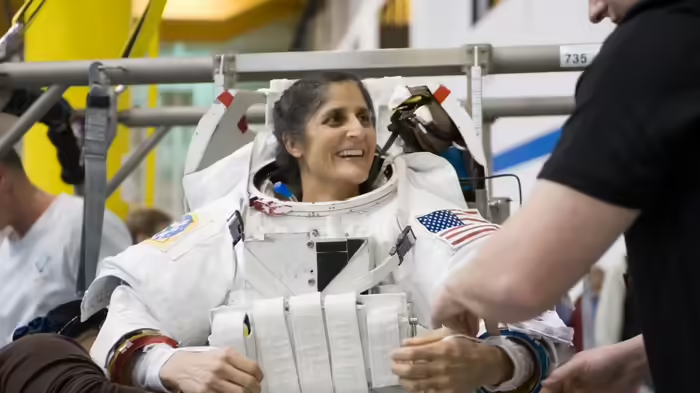
NASA Astronaut Qualification: When it comes to space exploration, the first name that comes to mind is NASA, the world’s premier space agency. But becoming an astronaut here requires the right qualifications and training.
Sunita Williams, the Indian-American astronaut, has retired after a remarkable 27-year career with NASA. The 60-year-old completed three space missions and spent an extended period aboard the International Space Station (ISS), setting multiple records along the way. Williams logged a total of 608 days in space, the second-highest ever by a NASA astronaut, and conducted nine spacewalks.
During her spacewalks, Williams spent 62 hours and 6 minutes outside the spacecraft, the longest duration for any female astronaut. Over nearly three decades, she has inspired millions of students to pursue careers in space exploration.
So, what educational background does one need to become a NASA astronaut like Sunita Williams? And what did Williams herself study to reach the stars? NASA provides the answer.
Sunita Williams’ Academic Journey
According to NASA, Sunita Williams earned a Bachelor of Science in Physical Science from the U.S. Naval Academy in 1987. She then joined the U.S. Navy as a naval aviator, trained as a helicopter pilot, and participated in several military operations. In 1995, she completed a Master of Science in Engineering Management at the Florida Institute of Technology and attended the Naval Test Pilot School the same year. By June 1998, she was selected for NASA’s astronaut program.
Educational Requirements to Become a NASA Astronaut
NASA states that aspiring astronauts should have a master’s degree in a STEM field—Science, Technology, Engineering, or Mathematics. This includes engineering disciplines such as mechanical, electrical, civil, and chemical engineering. Students with degrees in biological sciences, physical sciences, computer science, or mathematics are also eligible.
Additionally, pilot candidates must log at least 1,000 hours of flight experience, with 850 hours in jet aircraft.
Sunita Williams’ career demonstrates how a combination of strong academics, rigorous training, and dedication can make the dream of space travel a reality.
Discover more from SD NEWS agency
Subscribe to get the latest posts sent to your email.