
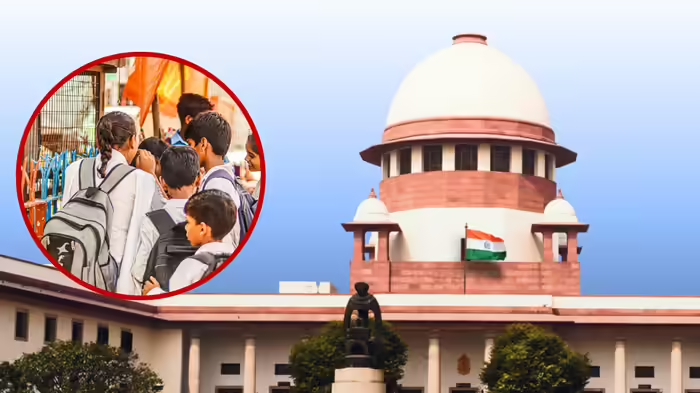
New Delhi: The Delhi government has informed the Supreme Court that the new law aimed at regulating arbitrary fee hikes in private schools will not be implemented during the ongoing 2025–26 academic session. Instead, the legislation will come into effect from the 2026–27 academic year.
Additional Solicitor General S.V. Raju, appearing for the Delhi government, told the court that the Delhi School Education (Transparency in Fixation and Regulation of Fees) Act, 2025 would be deferred. The statement came during a hearing before a bench comprising Justices P.S. Narasimha and Alok Aradhe, who were considering petitions filed by private school associations challenging the Act in the Delhi High Court.
Earlier, on January 19, the Supreme Court had observed that implementing the law in the middle of an academic session would be difficult and had asked the Delhi government to consider postponing it until April 2026. Following the government’s assurance that the Act would be enforced from next year, the court said its intervention was no longer required and disposed of the petition. However, the Delhi High Court will continue hearing challenges to the legislation.
The Act, introduced in December 2025, was designed to curb arbitrary fee increases by private schools and bring greater transparency to fee determination. Parents had expected relief from rising school fees this year, but the government’s clarification means implementation will be delayed.
Key Provisions of the Fee Regulation Law
The law proposes a multi-level committee system involving parents, teachers, school management, and government representatives to decide fee structures. School-level committees must finalize proposals by July 15 each year, with district reviews completed by July 30. Final decisions on fee revisions are to be taken by September.
Once enforced, private schools will not be allowed to raise fees without government approval. Violations could attract fines ranging from ₹1 lakh to ₹5 lakh, rising to ₹10 lakh for repeated offences. Schools failing to refund excess fees within the prescribed time may face escalating penalties, and habitual violators could lose their authority to revise fees altogether.
The law will apply to around 1,700 unaided private schools in Delhi and aims to establish a transparent and standardized process for fee regulation.
Discover more from SD NEWS agency
Subscribe to get the latest posts sent to your email.