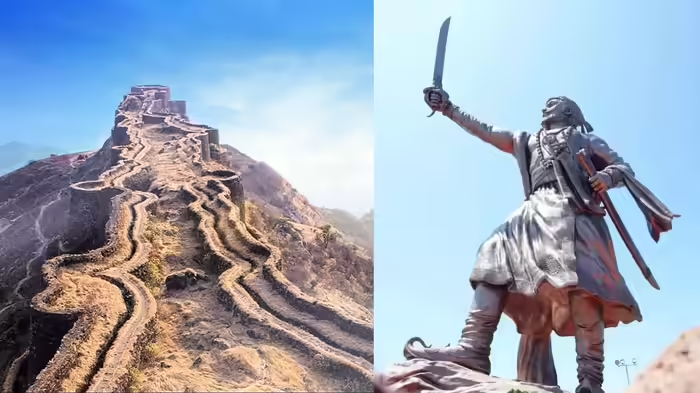
Today, 19th February, marks the birth anniversary of Chhatrapati Shivaji Maharaj, a legendary Maratha warrior who laid the foundation of the Hindavi Swarajya (Maratha Empire). Known for his exceptional military strategies and courage, Shivaji Maharaj captured hundreds of forts and repeatedly defeated the Mughal forces, earning a place in history as one of India’s greatest rulers. He is also celebrated as the Father of the Indian Navy.
Early Life and Background
Shivaji Maharaj was born on 19 February 1630 at Shivneri Fort, near present-day Pune, Maharashtra. His father, Shahaji Bhosale, served in the Bijapur Sultanate, and his mother, Jijabai, instilled in him a sense of pride, duty, and responsibility from a young age. Through stories from the Mahabharata and Ramayana, Jijabai nurtured his understanding of bravery and diplomacy.
Shivaji further honed his skills under the guidance of his mentor Dadoji Kondadev, learning swordsmanship, horse riding, spear throwing, and other martial arts. Training in the Sahyadri hills, he mastered guerrilla warfare tactics, known as Ganimi Kava, which became his hallmark strategy against larger forces.
Conquests and the Rise of a Kingdom
At just 15 years of age, Shivaji captured his first fort, Torna Fort, in 1645. From there, his journey of valor continued, eventually leading to the establishment of the Maratha Empire, also called Hindavi Swarajya. Shivaji’s policies consistently supported farmers and women, reflecting his commitment to justice and welfare.
On 6 June 1674, at Raigad Fort, Shivaji was formally crowned as Chhatrapati, marking the official foundation of the Maratha Empire.
Forts and Battles
Shivaji Maharaj captured over 200 forts during his lifetime, many of which he built himself. Twelve of these forts were included in the UNESCO World Heritage List in 2025, including 11 in Maharashtra and one in Tamil Nadu. Notable forts include:
- Raigad Fort
- Rajgad Fort
- Shivneri Fort
- Torna Fort
- Sindhudurg Fort
- Vijayadurg Fort
- Pratapgarh Fort
- Lohagad Fort
- Salher Fort
- Panhala Fort
- Gingee Fort (Tamil Nadu)
- Khanderi Fort
Shivaji fought more than 200 battles, major among them:
| Battle | Year | Opponents | Outcome |
|---|---|---|---|
| Pratapgarh | Nov 1659 | Afzal Khan vs Shivaji | Marathas won |
| Kolhapur | Dec 1659 | Adilshahi army vs Shivaji | Marathas won |
| Umberkhind | Feb 1661 | Kartalab Khan vs Shivaji | Marathas won |
| Sacking of Surat | Jan 1664 | Inayat Khan vs Shivaji | Marathas won |
| Purandar | 1665 | Raja Jai Singh vs Shivaji | Shivaji surrendered forts but preserved Swarajya |
| Singhgarh | Feb 1670 | Udaybhan Rathod vs Taanaji Malusare | Marathas won |
| Kalyan | 1682–1683 | Bahadur Khan vs Marathas | Mughals won |
| Sangamner | Nov 1679 | Marathas vs Mughals | Last battle fought by Shivaji |
Shivaji’s fight was not against any religion but against oppressive Mughal rule. His ultimate goal remained the establishment and protection of Hindavi Swarajya.
Father of the Indian Navy
Recognizing the importance of naval power to protect trade, Shivaji established the Maratha Navy, controlling nearly 100 km of the Konkan coastline by 1658. This earned him the title of Father of the Indian Navy by the Indian Navy.
Slogans and Legacy
His war cries, such as “Har Har Mahadev”, motivated his soldiers during battles, while “Hindavi Swarajya” reflected his vision for independent self-rule. Supporters often chanted “Jai Bhavani, Jai Shivaji” in his honor.
Death and Commemoration
Shivaji Maharaj passed away on 3 April 1680 at Raigad Fort, after battling illness. His son, Sambhaji, later ascended the throne after a brief struggle for succession.
In Maharashtra, Shivaji Jayanti is celebrated with parades, rallies, historical reenactments, and exhibitions at forts such as Raigad, Shivneri, and Singhgarh. These events honor his unparalleled courage and enduring legacy in Indian history.
Discover more from SD NEWS agency
Subscribe to get the latest posts sent to your email.