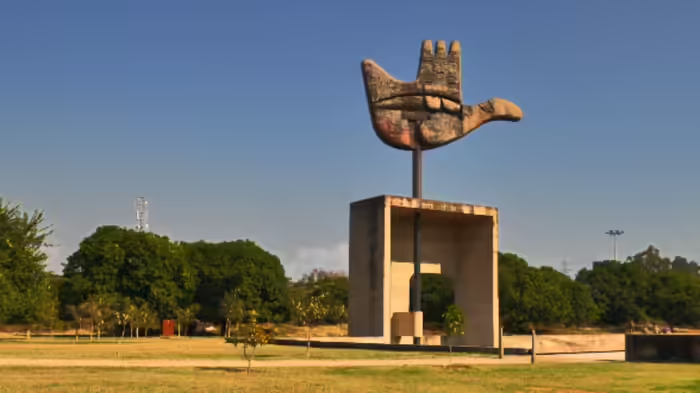
New Delhi: Some cities in India are renowned for their culture, history, and unique identity. Among them, Chandigarh stands out as a city with the rare distinction of being the capital of two states – Punjab and Haryana – as well as a Union Territory. Widely known as “The City Beautiful”, Chandigarh carries both historical and modern significance, making it a frequent topic in competitive exams and job interviews.
Capital of Two States
According to official sources (chandigarhdistrict.nic.in and chandigarh.gov.in), Chandigarh serves as the capital for both Punjab and Haryana. Geographically, it is bordered by Punjab to the north and west, and Haryana to the east and south. On November 1, 1966, Chandigarh was declared a Union Territory, giving it the additional status of an independent administrative center.
Why “The City Beautiful”?
Chandigarh’s reputation as a modern and aesthetically planned city earned it the nickname “The City Beautiful”. The city is located at the foothills of the Shivalik Hills and derives its name from the nearby Chandi Mandir (dedicated to the goddess Chandi) and the historic garh (fort) behind it. Designed under the vision of India’s first Prime Minister Jawaharlal Nehru, the city features landmarks like Sukhna Lake, Rock Garden, Chandigarh Gallery, and Leisure Valley, which enhance its scenic charm.
A History Stretching Thousands of Years
Long before its modern planning, the area where Chandigarh now stands was a large lake and wetland, inhabited by aquatic and semi-aquatic species. Fossil evidence indicates human and ecological activity dating back nearly 8,000 years, connecting the region to the Indus Valley Civilization. Throughout history, it was part of Punjab and served as a center for various cultural and administrative activities.
Chandigarh’s Modern Development
Following the Partition of India in 1947, Punjab was divided into eastern and western regions. Eastern Punjab required a new capital, and in March 1948, the Indian government approved the construction of a new city at the foothills of the Shivaliks. Chandigarh’s foundation was laid in 1952, not only serving as the capital of Eastern Punjab but also providing housing for thousands of refugees from West Punjab. After the reorganization of states in 1966, Chandigarh became the shared capital of Punjab and Haryana and a Union Territory, marking its unique position on India’s administrative map.
Chandigarh continues to symbolize a perfect blend of heritage, planning, and modernity, truly deserving the title “The City Beautiful”.
Discover more from SD NEWS agency
Subscribe to get the latest posts sent to your email.